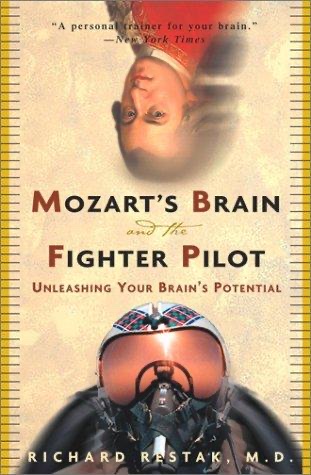
Cover of Mozart's Brain and the Fighter Pilot

Mozart's Brain and the Fighter Pilot

Richard Restak

6 ideas

  1. Intelligence Is Trainable, Not Fixed

    Cognitive capacity is not a static inheritance but a malleable system that responds to deliberate exercise, much like muscle responds to physical training. Specific mental practices — memorization, sensory discrimination, sustained attention — measurably increase functional intelligence at any age.

  2. Working Memory As Bottleneck

    The number of items you can hold in active mind at once limits the complexity of thought you can perform, since reasoning requires manipulating multiple elements simultaneously. Expanding working memory through chunking and practice directly raises the ceiling on what problems you can solve.

  3. Knowledge Webs Beat Isolated Facts

    Memory and understanding strengthen when new information is linked to existing knowledge rather than stored in isolation, because retrieval depends on the density of associative connections. Deliberately cross-referencing facts across domains builds a web where each node makes the others easier to recall and apply.

  4. Attention As The Master Faculty

    What you become skilled at is determined by what you attend to, because the brain devotes neural resources to repeatedly activated circuits. Treating attention as the controllable input to all cognitive enhancement reframes self-improvement as the disciplined management of where focus is directed.

  5. The Fighter Pilot's Compressed Perception

    Fighter pilots train to process rapidly changing visual and spatial information faster than untrained people, perceiving and deciding within fractions of a second. This demonstrates that even high-speed perceptual judgment is a trainable skill rather than a fixed reflex limit.

  6. Sensory Acuity Sharpens Thinking

    Deliberately refining the senses — distinguishing subtle differences in taste, sound, or sight — enriches the raw material the brain has to reason with and remember. Cultivating fine sensory discrimination, as a wine taster or musician does, expands cognitive power by increasing the resolution of incoming experience.

Save and mark ideas in the app