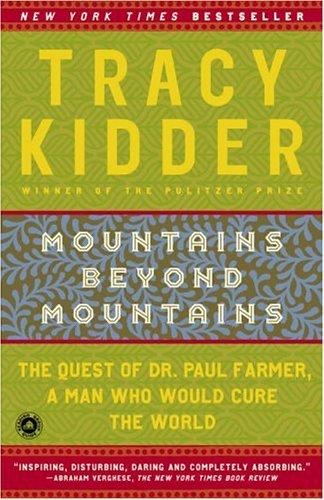
Cover of Mountains Beyond Mountains

Mountains Beyond Mountains

Tracy Kidder

5 ideas

  1. Walking Hours To Deliver One Patient's Medicine

    Farmer would hike for hours through Haitian terrain to check on a single patient, an act others saw as wildly inefficient use of a brilliant doctor's time. He argued that the willingness to make that journey is precisely what proves to the poor that their lives count, and that abandoning it corrupts the whole enterprise.

  2. Accompagnateurs and the Cange clinic model

    In Cange, Haiti, Zanmi Lasante trained community health workers called accompagnateurs to visit patients daily, watch them take their drugs, and connect them to food, housing, and cash support. This model achieved high adherence and cure rates among the poorest patients, rebutting the claim that the poor could not follow complex regimens and showing that adherence failures stemmed from poverty's logistics rather than patient character.

  3. Preferential option for the poor

    Borrowed from liberation theology, this principle holds that when resources are limited, care should go first and fully to the poorest, rather than to whoever yields the most measurable return. In practice, Farmer applied it as an operating rule: the patient in front of you who has the least gets the full standard of care, even when that means a days-long hike to a single home.

  4. Cost-effectiveness arguments encode acceptance of death

    Farmer argues that labeling MDR-TB treatment 'not cost-effective' in poor countries treated scarcity as a fixed law when it was a decision about who gets resources. By negotiating drug prices down and demonstrating cure rates in Peruvian slums comparable to rich-country outcomes, Partners In Health showed that the cost was set by pharmaceutical pricing and policy, not biology, so the 'realistic' standard of care was itself producing the drug resistance it claimed to be managing.

  5. Structural violence as the cause of disease

    Illness among the poor is read not as bad luck or individual behavior but as the predictable result of economic and political arrangements, such as dispossession by a dam, poverty wages, and denied access to care, that determine who gets sick and who dies. Seen this way, a TB death in rural Haiti becomes an injury inflicted by social structures, and medicine becomes a form of redress rather than a charity.

Save and mark ideas in the app