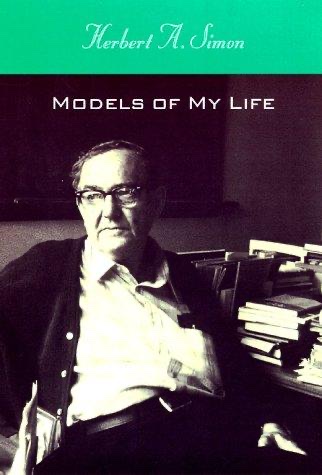
Cover of Models of My Life

Models of My Life

Herbert A. Simon

5 ideas

  1. Bounded Rationality Replaces Optimizing

    Human decision-makers cannot evaluate all alternatives or compute optimal outcomes because their cognitive capacity, time, and information are limited. Instead of maximizing, they construct simplified mental models of the situation and reason within those bounds, making rationality a property constrained by the architecture of the mind rather than the structure of the world.

  2. Satisficing Over Maximizing

    Rather than searching for the best possible option, people set an aspiration level — a 'good enough' threshold — and accept the first alternative that meets it. This stops search at a feasible point, which is how real organisms and organizations actually decide under complexity and limited resources.

  3. Thinking Is Symbol Manipulation

    Human problem-solving consists of manipulating symbol structures according to rules, which means intelligence can in principle be reproduced by any physical system that processes symbols — including a computer. This makes cognition a subject for empirical, mechanistic study rather than something uniquely biological or mysterious.

  4. A Life Modeled as Maze-Running

    A career or life can be viewed not as a planned trajectory toward fixed goals but as path-dependent navigation through a branching maze, where each choice is shaped by local conditions and prior turns. Viewed this way, achievement reflects the contingent structure of opportunities encountered as much as deliberate intention or talent.

  5. Milwaukee Recreation Budget Study, 1935

    In 1935, as a University of Chicago undergraduate, Herbert Simon returned to his hometown of Milwaukee to study how the city's recreation department budget was split between playground maintenance, overseen by public works, and recreation staff, overseen by the school board. He found that officials did not weigh the marginal value of a dollar spent on each, as economic theory predicted. Each side pushed for its own activities based on its own goals, and Simon later traced his theory of organizational decision-making to this observation.

Save and mark ideas in the app