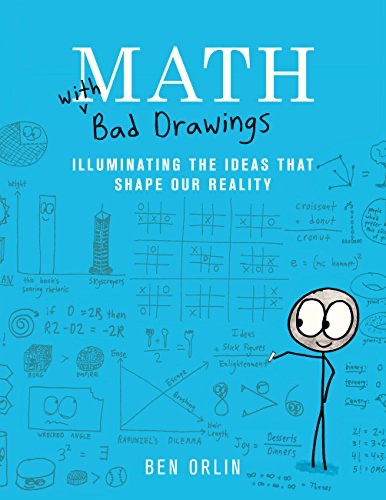
Cover of Math with Bad Drawings

Math with Bad Drawings

Ben Orlin

6 ideas

  1. Mathematics Is Thinking, Not Calculation

    The core of mathematics is not getting numbers right but reasoning carefully about abstractions and their relationships. Treating math as mechanical computation misses that its actual value lies in the disciplined logic and pattern-recognition behind the symbols.

  2. A Number Is A Compression Of Reality

    Any single number that summarizes something — a test score, a GDP, a batting average — discards enormous detail to gain portability. The act of measurement always trades richness for comparability, and forgetting what was thrown away leads to false confidence in the figure.

  3. The Lottery As A Tax On Hope

    Lotteries pay out far less than they take in, making them mathematically guaranteed losers for buyers, yet millions play because they price the fantasy of winning rather than the expected value. The example shows how people purchase emotional possibility while ignoring the actual probabilistic structure.

  4. See Statistics As Stories With Variance

    Every dataset is not a fixed fact but a sample drawn from a process that could have turned out otherwise, so a single result is one story among many possible ones. Viewing numbers this way forces attention to the spread and uncertainty rather than treating any measured value as definitive.

  5. Models Are Useful Lies, Not Truth

    A mathematical model deliberately simplifies reality, so the right question is never whether it is true but whether its distortions are tolerable for the decision at hand. Judging a model demands knowing which features it captures and which it ignores, then checking that the ignored ones don't dominate your situation.

  6. Tiny Probabilities Compound Catastrophically

    Risks that seem negligible in isolation become near-certainties when repeated across many trials or correlated across a system, as when many small mortgage defaults aligned to trigger a financial collapse. Misjudging independence and accumulation turns 'unlikely' events into predictable disasters.

Save and mark ideas in the app