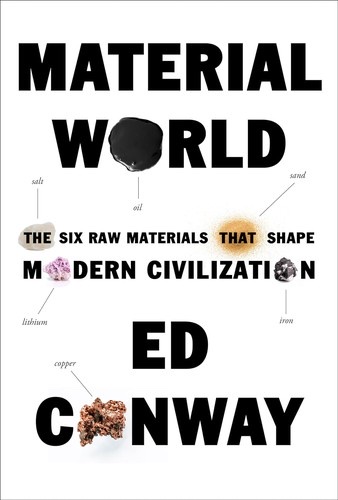
Cover of Material World

Material World

Ed Conway

8 ideas

  1. Refining Matters More Than Mining

    Geopolitical power over critical materials lies less in who owns the deposits and more in who controls the processing and refining capacity. A country can dominate a resource it barely extracts simply by building the industrial chemistry to purify it, as seen with China's grip on rare earths and lithium refining.

  2. The Invisible Cost of Cheap Abundance

    Materials become invisible precisely when they become cheap and ubiquitous, causing societies to underinvest in and ignore the fragile systems that produce them. This complacency creates hidden vulnerabilities, where a disruption to a single overlooked input — like a fertilizer ingredient or a refining plant — can cascade across the global economy.

  3. Ultra-pure quartz behind every silicon chip

    Semiconductors begin as ordinary-seeming sand, but making the crucibles used to grow near-perfect silicon crystals requires exceptionally pure quartz, found in commercial quantity at very few sites such as Spruce Pine, North Carolina. A cutting-edge chip then passes through a chain of highly specialised facilities in different countries, each close to a single point of failure. Humble raw inputs and extreme concentration make the most advanced industry on earth surprisingly fragile.

  4. The hidden material world beneath digital life

    Modern economies are usually described in terms of services, software and data, which makes physical extraction look like a shrinking relic. Tracing any digital product back to its inputs reveals the opposite: phones, data centres and networks rest on quarries, mines, brine pools and refineries that most consumers never see. The 'immaterial' economy is really a thin layer sitting on a vast and still-growing physical base.

  5. Few foundational materials underpin everything

    A small set of basic substances (sand, salt, iron, copper, oil and lithium) serve as the building blocks for nearly everything modern life depends on, from glass and concrete to steel, wiring, plastics, fertiliser and batteries. Salt, for example, feeds the chlor-alkali industry behind chemicals used in water treatment and PVC. Viewing civilisation through these inputs shows how disrupting one raw material can cascade across countless unrelated products.

  6. Falling ore grades raise extraction's footprint

    The richest, most accessible deposits are exploited first, so over time the average concentration of metal in mined ore declines. At giant copper mines such as those in Chile's Atacama, producing the same tonnage of metal means moving and crushing ever larger volumes of rock, using more energy, water and land. Headline output figures hide this steadily rising physical effort per unit of metal.

  7. Decarbonisation requires more mining, not less

    Replacing fossil fuels with electric vehicles, batteries, wind turbines and grids sharply increases demand for copper, lithium, nickel, iron and other minerals. A 'green' transition therefore means opening more mines and processing more rock, with local environmental and social costs, rather than escaping extractive industry altogether.

  8. Extraction is accelerating, not declining

    Despite efficiency gains and talk of a post-industrial economy, humanity now digs, dredges and blasts more material from the earth each year than ever before, far exceeding historical levels. Efficiency lowers the material cost per unit, but rising demand and new technologies more than cancel it out, so absolute extraction keeps climbing.

Save and mark ideas in the app