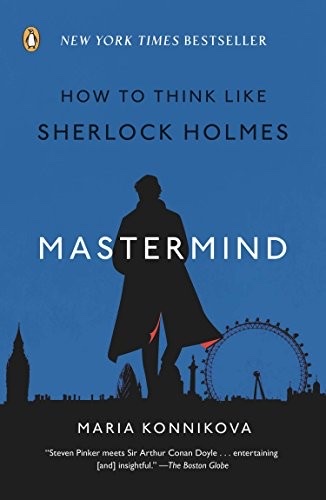
Cover of Mastermind: How to Think Like Sherlock Holmes

Mastermind: How to Think Like Sherlock Holmes

Maria Konnikova

6 ideas

  1. Brain Attic as Curated Storage

    The mind is like an attic with finite space, and what you store and how you organize it determines what you can retrieve later. Unlike a passive collection of whatever drifts in, a well-kept mental attic requires deliberate selection of what to admit and active arrangement so that relevant knowledge can be connected when needed.

  2. System Holmes Versus System Watson

    Thinking operates in two modes: fast, intuitive, lazy Watson-thinking that jumps to conclusions, and slow, effortful, deliberate Holmes-thinking that observes and reasons. Becoming a better thinker means consciously engaging the Holmes mode rather than defaulting to automatic mental shortcuts.

  3. Observation Differs From Mere Seeing

    Most people see without observing — they register a scene passively without attending to its specific details. True observation is an active, motivated process where you decide in advance what matters and direct attention deliberately, which is why two people can look at the same thing and notice entirely different facts.

  4. Mindful Presence Precedes Good Reasoning

    Sound deduction depends first on being fully present and engaged in the moment rather than operating on autopilot. Distraction and multitasking degrade the quality of inputs, so cultivating focused mindfulness is the prerequisite that makes accurate inference possible.

  5. Hypothesis After Data, Not Before

    Forming a theory before gathering facts causes you to twist evidence to fit preconceptions, a capital mistake in reasoning. The disciplined sequence is to collect observations first, then generate explanations and test them against the data, holding conclusions loosely until evidence forces them.

  6. Imagination Powers Deductive Leaps

    Reasoning is not purely cold logic; it requires imagination to generate the range of possible explanations that logic then tests and eliminates. Stepping back to let the mind wander and recombine observations — rather than grinding mechanically — is what produces creative insight into a problem.

Save and mark ideas in the app