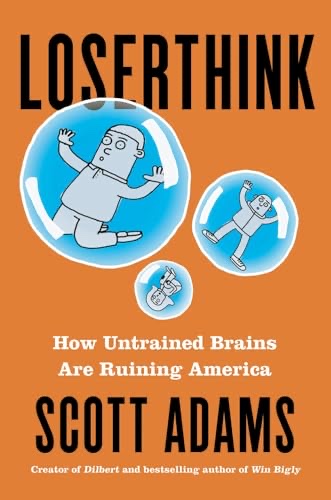
Cover of Loserthink

Loserthink

Scott Adams

6 ideas

  1. Mental Prisons Built By Single Disciplines

    People trained in only one field reason inside that field's assumptions and mistake those assumptions for reality, producing what Adams calls 'loserthink.' Borrowing thinking habits from multiple disciplines — economics, engineering, psychology, science — lets you escape the blind spots any single discipline imposes.

  2. Think Like An Engineer About Tradeoffs

    Engineering reasoning treats every choice as a tradeoff with no perfect option, only better and worse balances of cost, risk, and benefit. When you catch yourself demanding a flawless solution or rejecting an option for any downside, you're ignoring that all real choices involve accepting some bad with the good.

  3. Mind Reading As A Thinking Error

    Claiming to know the hidden motives, intentions, or feelings behind someone else's actions is a fabrication dressed as analysis. Most conflict and bad reasoning comes from confidently asserting why people did things when you only observed what they did, not why.

  4. Compare To Alternatives, Not To Perfection

    A plan, policy, or person should be judged against the realistic alternatives available, not against an imaginary ideal. Criticizing something for being imperfect is meaningless unless you can name a specific option that performs better on the relevant dimensions.

  5. Feelings Disguised As Reasons

    People routinely experience an emotional reaction first and then manufacture rational-sounding justifications for it, while believing the reasoning came first. Recognizing when your 'arguments' are actually post-hoc defenses of a feeling is the precondition for thinking clearly about emotionally loaded topics.

  6. Reframing To Escape Useless Mental States

    Many emotional and motivational problems are not solved by facts but by adopting a more useful interpretation of the same situation. Swapping a draining frame for an energizing one — without lying to yourself — changes your behavior and outcomes even when the underlying facts are unchanged.

Save and mark ideas in the app