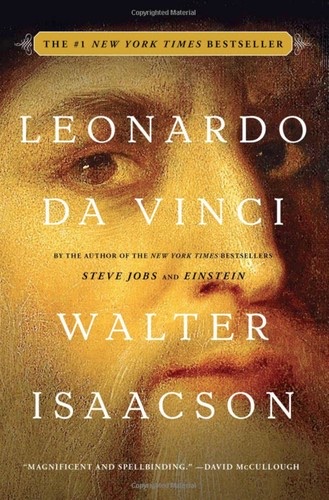
Cover of Leonardo da Vinci

Leonardo da Vinci

Walter Isaacson

5 ideas

  1. Curiosity Without Utility Drives Discovery

    Leonardo pursued questions for their own sake — why the sky is blue, how a woodpecker's tongue works, why fossils sit atop mountains — with no expectation of practical payoff. This relentless, purposeless curiosity, often dismissed as undisciplined, was the engine that fed his ability to see across disciplines and connect unrelated phenomena.

  2. Observation Sharpened by Active Looking

    Leonardo trained himself to observe by breaking phenomena into sequences and noticing details others glossed over — like how a dragonfly's four wings move in alternating pairs. Skilled perception is not passive seeing but a deliberate, repeatable practice of slowing down and questioning what the eye assumes it already knows.

  3. Art and Science as One Inquiry

    Leonardo treated anatomy, optics, hydraulics, and geometry as inseparable from painting — the smile of the Mona Lisa emerged from his dissection of facial muscles and study of how light scatters. Viewing artistic and scientific questions as a single unified inquiry reveals patterns invisible to those who keep the two domains apart.

  4. Unfinished Work as a Feature

    Leonardo left many commissions incomplete and carried the Mona Lisa for years, refusing to declare projects done because he kept perceiving improvements and unresolved questions. The willingness to leave things open — to value the pursuit of perfection over delivery — can coexist with genius and is sometimes inseparable from it.

  5. The Sforza Horse That Was Never Cast

    In Milan, Duke Ludovico Sforza commissioned Leonardo to build a colossal bronze equestrian monument to his father Francesco. Leonardo spent years studying horse anatomy and devising new casting methods, and in 1493 he displayed a full-size clay model more than 20 feet tall. In 1494 the roughly 75 tons of bronze set aside for it went to Ferrara to be cast into cannons against the invading French, and in 1499 French archers occupying Milan used the clay horse for target practice and destroyed it.

Save and mark ideas in the app