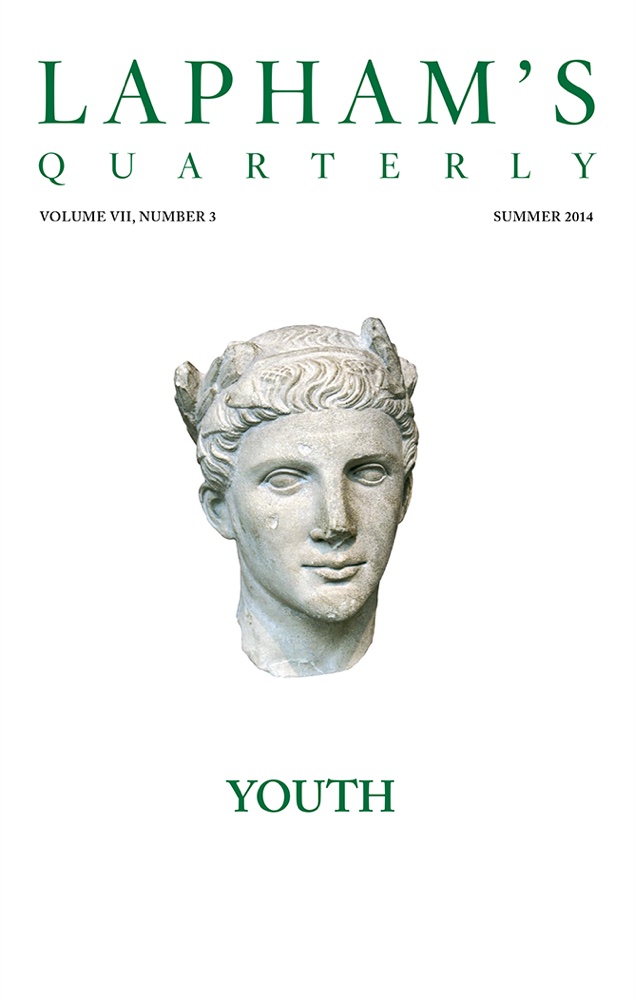
Cover of Lapham's Quarterly: Youth

Lapham's Quarterly: Youth

Lewis H. Lapham (ed.)

4 ideas

  1. Youth Exists Only as Elders' Projection

    Youth is not experienced as a coherent stage by those living it, but constructed retrospectively by adults who see it as either enviable beauty or unbearable trial. This means every account of 'youth' reveals more about the observer's distance and nostalgia than about the young themselves.

  2. Childhood's Freedom From Memory Is Ambivalent

    The absence of accumulated memory in childhood means the young are untroubled by regret over past sorrows, but this same emptiness leaves them without the consolation that remembered suffering can provide. Innocence is thus not pure gain — it removes both the burden and the comfort that experience supplies.

  3. Child Mortality as Statistical Expectation

    In eras of high infant death, the loss of a newborn before its parents was understood not as a violation of natural order but as the probable outcome — Gibbon survived while his six siblings died in infancy. This reframes grief-worthiness: what feels like tragedy in one demographic regime is the baseline expectation in another.

  4. Coming-of-Age as Ritual Boundary-Marking

    Societies convert the biological drift from child to adult into a discrete, socially recognized transition through rites of passage that mark a before and after. The ritual creates the category shift that biology alone cannot deliver, giving communities a shared moment to relocate a person's status and obligations.

Save and mark ideas in the app