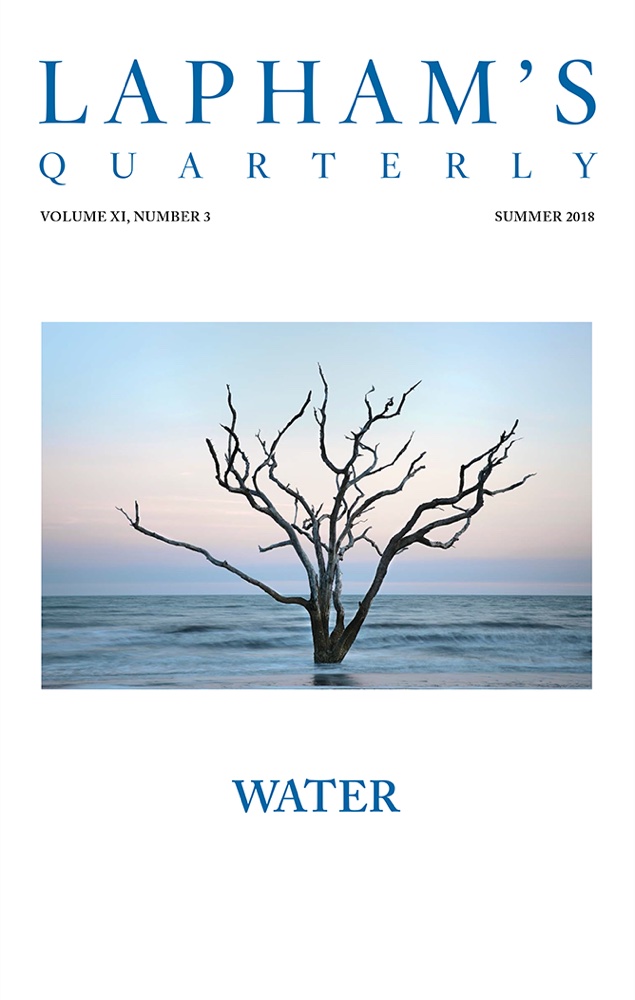
Cover of Lapham's Quarterly: Water

Lapham's Quarterly: Water

Lewis H. Lapham (ed.)

4 ideas

  1. Eliminating vectors beats treating disease

    Public health advances often arrive not through medical treatment but through the abolition of shared physical practices — banning the communal drinking cup at fountains cut disease transmission by removing a vector rather than curing the sick. Fear-based framing ('the cup of death,' the Grim Reaper luring a child) mobilized political action faster than statistics did.

  2. Scale of observation redefines what exists

    Viewing a single drop of water through a microscope reveals it as a teeming ecosystem of living organisms, dissolving the boundary between 'inert substance' and 'habitat.' What appears clean, empty, and singular at human scale is dense, crowded, and alive at another scale — the observed reality depends entirely on the instrument's resolution.

  3. Water hidden in unconventional reservoirs

    Water can be extracted from sources that seem impossibly barren — condensed from air humidity, drawn from deep bedrock, or recycled from human urine aboard spacecraft. Scarcity is often not an absolute absence but a problem of unlocking water bound in unconventional reservoirs through engineering.

  4. Living with floods as normal rhythm

    The marsh Arabs of southern Iraq have sustained a civilization built directly on wetland flooding for millennia, living with recurring inundation rather than fighting it. Their adaptation reframes catastrophic flood myths like Noah's as descriptions of a normal, livable ecological rhythm rather than singular divine punishments.

Save and mark ideas in the app