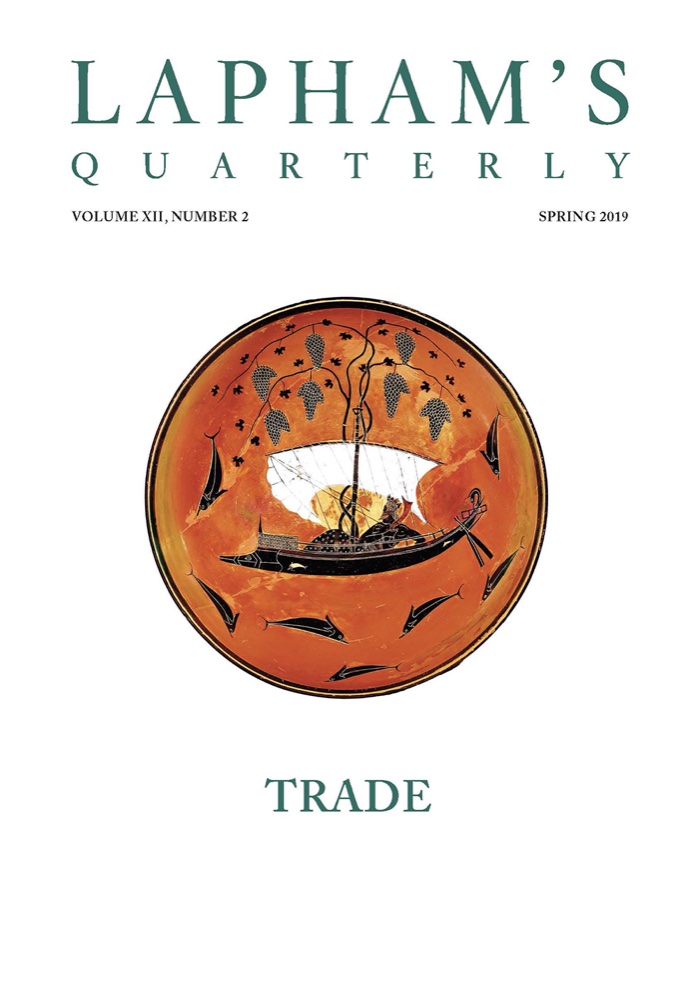
Cover of Lapham's Quarterly: Trade

Lapham's Quarterly: Trade

Lewis H. Lapham (ed.)

4 ideas

  1. Trade as the engine of civilization and conflict

    The same exchange networks that spread goods, technologies, and ideas across distant cultures also create the dependencies, rivalries, and inequalities that provoke war and exploitation. Commerce is therefore not a benign or neutral force but a double-edged mechanism that simultaneously binds and divides human societies.

  2. Money as moralized language across eras

    Every historical period encodes its anxieties and aspirations in how it talks about money — as sin, as freedom, as virtue, or as corruption — so the vocabulary of wealth reveals a culture's deepest values more than its explicit philosophy. Reading economic language as moral testimony exposes what a society fears and worships.

  3. The merchant as cultural intermediary

    Traders function as carriers of more than goods: by moving between societies they transmit languages, religions, customs, and innovations that the merchants themselves often neither intend nor control. The figure of the merchant thus becomes the unintended vector of cultural change, more transformative than armies or rulers.

  4. Pricing the unpriceable corrupts the sacred

    When societies extend market logic to things previously held outside exchange — human beings, honor, justice, the divine — the act of assigning a price reshapes how those things are valued and ultimately degrades them. The boundary a culture draws around what may not be sold defines its conception of human dignity.

Save and mark ideas in the app