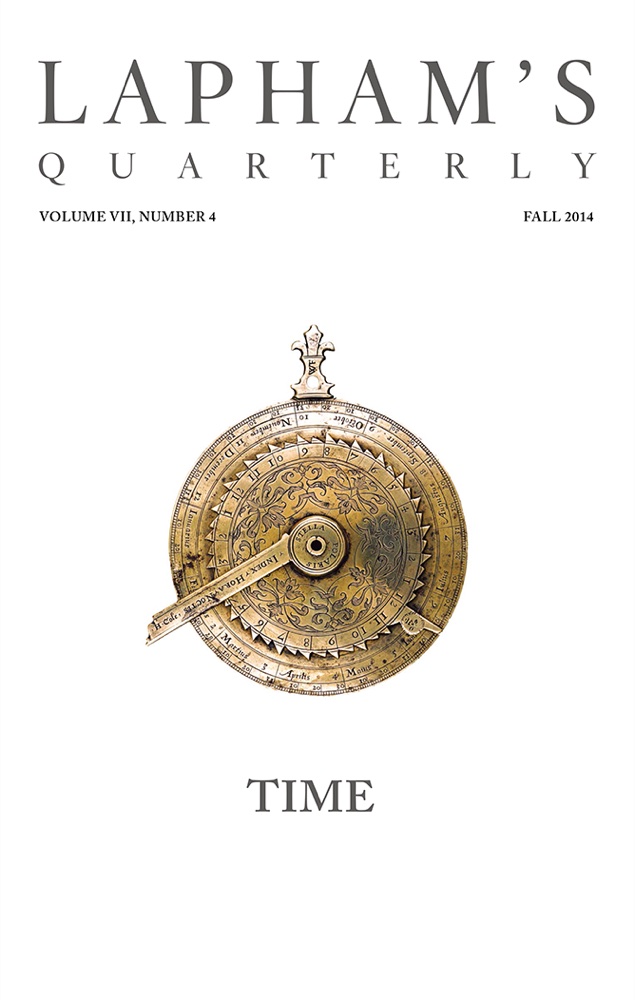
Cover of Lapham's Quarterly: Time

Lapham's Quarterly: Time

Lewis H. Lapham (ed.)

4 ideas

  1. The Now Cannot Be Both Before and After

    If the present 'now' were identical across all moments, then events ten thousand years apart would be simultaneous, collapsing all sequence and making 'before' and 'after' meaningless. The reality of temporal order therefore proves that each 'now' is distinct and non-repeating, not a single eternal instant.

  2. Death-Awareness As the Human Time Sense

    Animals grow old while trapped in a present moment that feels eternal to them, but humans alone perceive their own mortality and thereby experience the flow of time as loss and finitude. Because we know we will die, we do not merely exist in time — we are time, defined by our consciousness of its passing.

  3. Effort Undermined by Equal Reward

    When diligent and lazy workers receive identical pay, the industrious worker's motivation collapses because effort is measured relative to reward, not in absolute terms. This reframes productivity as a function of perceived fairness in the exchange of time for compensation rather than of individual character.

  4. The Present As the Most Terrifying Revelation

    The immediate present moment — stripped of the buffering distance of past memory or future anticipation — can be more frightening than any distant event, because it confronts us directly with unmediated existence. Confronting 'now' without narrative insulation exposes a rawness that the mind normally avoids.

Save and mark ideas in the app