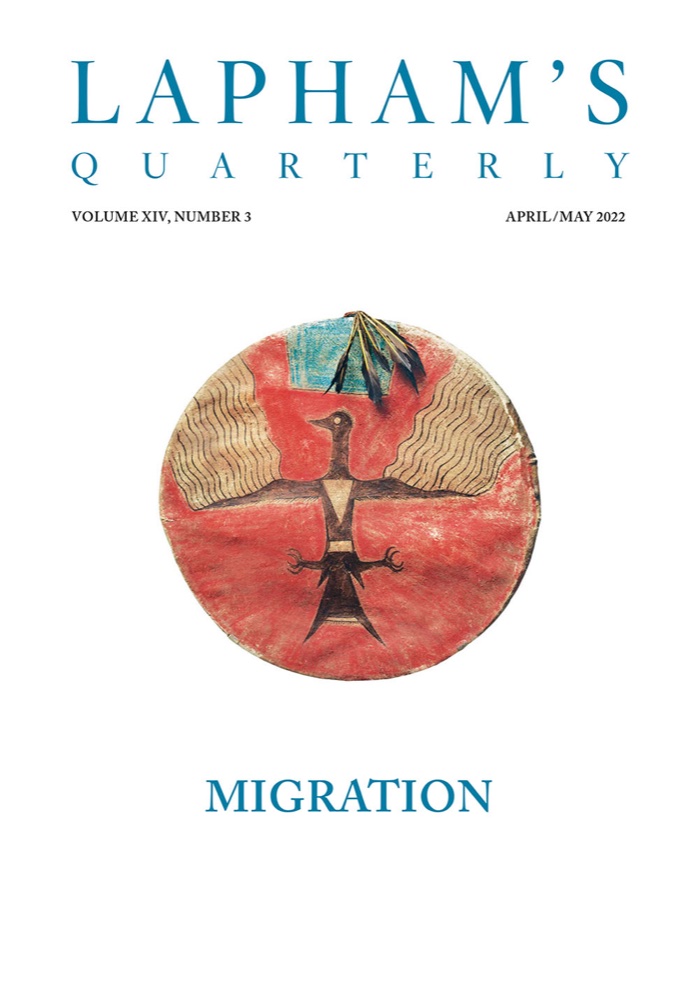
Cover of Lapham's Quarterly: Migration

Lapham's Quarterly: Migration

Lewis H. Lapham (ed.)

4 ideas

  1. Uprootedness Spreads Itself Through Society

    When people are torn from their roots, the resulting instability doesn't stay contained — the uprooted tend to uproot others in turn, propagating the condition outward. This makes displacement uniquely dangerous compared to other social ills because it is self-perpetuating rather than self-limiting.

  2. Freedom Acquired Through Physical Departure

    For some, crossing a border grants not just a new location but a new legal and social status unavailable at home — Black doctors who earned degrees in Europe gained a form of freedom that no achievement inside their origin country could confer. Movement itself becomes the mechanism of emancipation because rights are geographically contingent, not portable.

  3. The Public Domain Belongs To Everyone

    Certain spaces — the open sea, and by extension routes of passage — cannot be owned by any single nation because they are common to all humanity, making free transit across them a natural right rather than a privilege granted by states. This reframes migration restrictions as encroachments on a shared commons rather than legitimate exercises of sovereignty.

  4. Migrants As Sacred Rather Than Prey

    The same arriving stranger can be read as a resource to exploit or as a being on a purposeful, protected journey — Khuzestan villagers refused to hunt unusual migratory birds because they interpreted them as pilgrims performing a hajj. How a receiving community frames the transient determines whether it welcomes, ignores, or preys upon them.

Save and mark ideas in the app