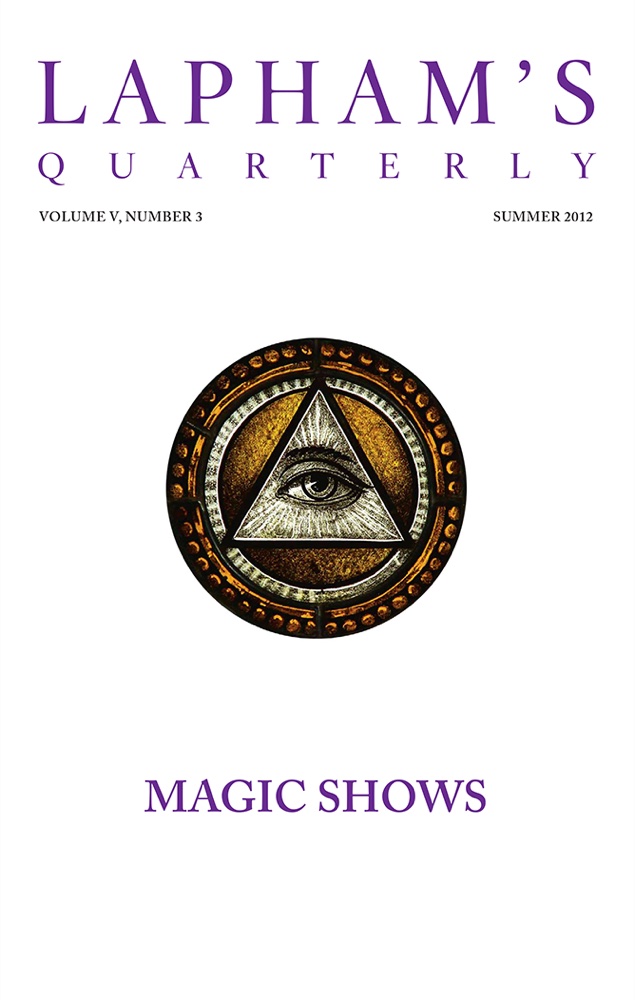
Cover of Lapham's Quarterly: Magic Shows

Lapham's Quarterly: Magic Shows

Lewis H. Lapham (ed.)

4 ideas

  1. Stagecraft and occultism share a lineage

    The techniques of theatrical special effects — lighting, mechanical illusion, atmospheric spectacle — developed hand in hand with the culture of the occult, because both trade in the manufacture of wonder. Philippe Jacques de Loutherbourg's career as scenographer shows that the machinery of belief and the machinery of entertainment are the same apparatus.

  2. Sorcery accusation resolved by ordeal

    The Code of Hammurabi handles unproven sorcery charges by throwing the accused into the river: drowning proves guilt while survival proves innocence and condemns the accuser. This converts an unverifiable metaphysical claim into a physical test whose outcome society agrees to treat as truth.

  3. The marvelous endures despite science

    Human appetite for the illusory and the marvelous does not recede as knowledge advances; it migrates into new forms, from crystal balls to political rhetoric justifying war. What looks like superstition and what looks like rational policy can rest on the same craving for a compelling story over verified fact.

  4. Science strips wonder from the world

    Poe's lament frames scientific explanation as a predatory force that dissects and destroys the objects of imaginative delight, driving out the mythic and the numinous. The advance of empirical knowledge is experienced not as gain but as impoverishment of the felt world.

Save and mark ideas in the app