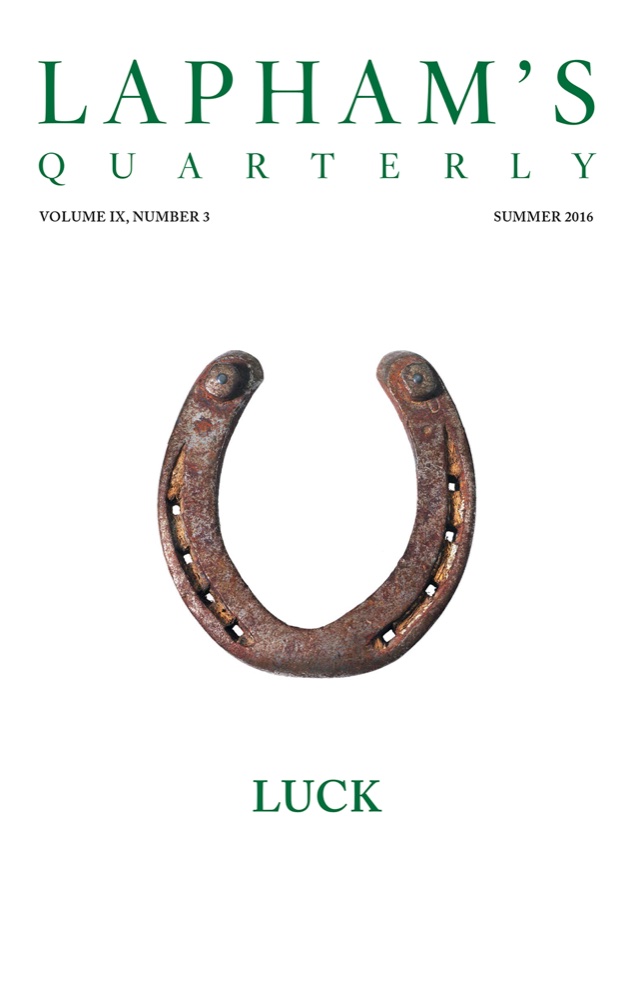
Cover of Lapham's Quarterly: Luck

Lapham's Quarterly: Luck

Lewis H. Lapham (ed.)

4 ideas

  1. The Wheel of Fortune's Indifference

    Fortune is personified as a blind goddess turning a wheel that raises and drops people without regard to merit or effort. The same figure who elevates a Caesar can reverse his position instantly, making elevation and ruin two positions on a single continuous cycle rather than rewards and punishments.

  2. Attributed Wisdom Often Fabricated Retroactively

    The famous line 'the harder I work the more luck I have' was invented by a 1922 humorist and only later assigned to Thomas Jefferson to lend it authority. Aphorisms migrate to prestigious names because a quote's credibility is drawn from its supposed author, not from whoever actually wrote it.

  3. Handicapping As Engineered Fairness

    Handicapping deliberately adds weight or disadvantage to superior competitors so that outcomes stay uncertain and every contestant retains a plausible chance. By manufacturing artificial equality of odds, it converts a predictable contest into one whose result depends on chance, making the event worth wagering on and watching.

  4. Fortune's Asymmetry Between Gain And Loss

    Good fortune is light as a feather yet impossible to hold onto, while misfortune is heavy as earth yet impossible to avoid. Viewing luck through this asymmetry reframes success as slippery and temporary and failure as gravitationally likely, correcting the instinct to treat both as equally controllable.

Save and mark ideas in the app