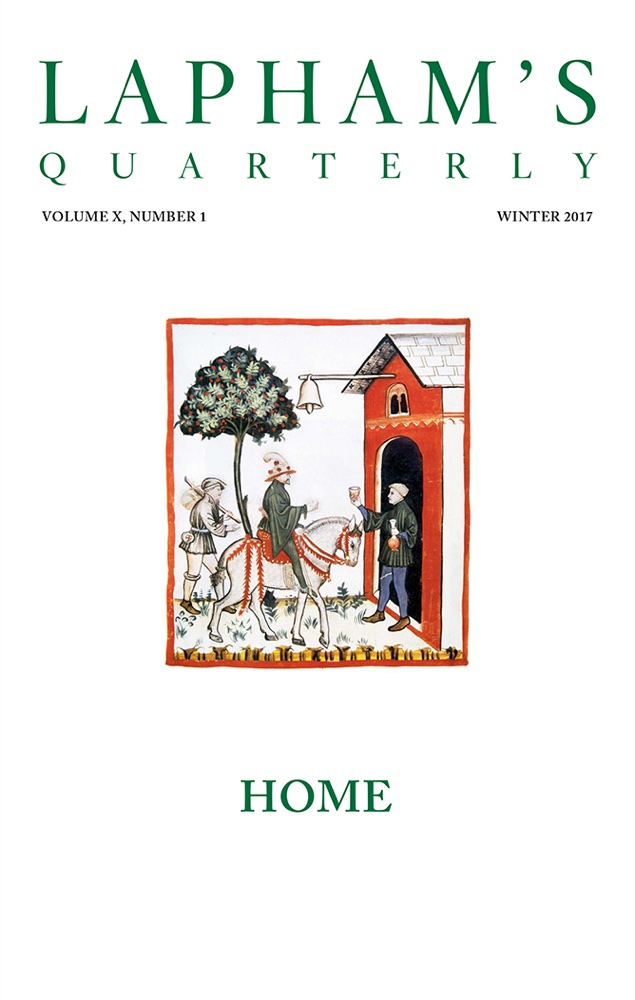
Cover of Lapham's Quarterly: Home

Lapham's Quarterly: Home

Lewis H. Lapham (ed.)

4 ideas

  1. Concentrated Land Ownership Breeds Instability

    When the concentration of land ownership pushes small holders off the soil, the displaced don't disappear — they become a landless, dependent underclass whose loss of a stake destabilizes the whole society. The health of a polity can be read by whether ordinary people still have a piece of ground to call their own.

  2. Absence Of Ugliness Versus Ugliness

    The value of a dwelling can be judged by the absence of specific offenses rather than the presence of positive virtues — a room without ugliness may feel emptier and more disturbing than one that is actively ugly. Negative space and blandness are themselves aesthetic conditions worth naming, not neutral defaults.

  3. Painted Structure That Bears No Load

    Interior surfaces can depict architectural elements—columns, candelabra, supports—that carry no real structural load, mimicking function purely for effect. Vitruvius condemned this as illustrating things that 'neither are, nor can be, nor have been,' marking a fault line between decoration that honors reality and decoration that fabricates it.

  4. Home As Load-Bearing National Myth

    The idea of home as a secure possession is treated as a foundational myth of collective aspiration—'castles in air'—so its stability tracks with the health of the larger dream it symbolizes. When ordinary people can no longer expect to hold a home, the shared imaginative project underwriting the whole society begins to dissolve.

Save and mark ideas in the app