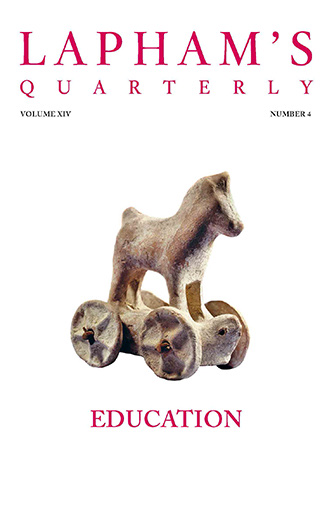
Cover of Lapham's Quarterly: Education

Lapham's Quarterly: Education

Lewis H. Lapham (ed.)

4 ideas

  1. Spending patterns expose institutional priorities

    The most contested budget line in universities is not teaching but administration: between 2012 and 2018 noninstructional spending grew faster than instructional spending, while institutions substituted cheaper, less-credentialed instructors for tenured faculty. This reveals that the priorities of an educational institution are exposed by where money flows, not by its mission statements.

  2. Schooling originated as scribe-manufacturing for the state

    In ancient Mesopotamia, literacy was manufactured in the 'tablet house,' where scribes were produced through relentless copying, memorization, and physical discipline rather than open inquiry. Education originated as a technology for reproducing a small trained class that could administer the state, meaning schooling was first designed to make functionaries, not free thinkers.

  3. Curriculum as citizen-manufacturing apparatus

    When a regime 'intensifies class education,' it treats schools as instruments for forming loyalty and enforcing an official worldview rather than for developing individual judgment. Viewing any curriculum through this lens asks not 'what does this teach?' but 'what kind of citizen is this designed to produce?'

  4. Knowledge as the only defense against the world

    Locke argued that the only reliable defense against a hostile world is 'a thorough knowledge of it' — protection comes from understanding reality, not from being sheltered from it. This reframes education's purpose as inoculation through exposure rather than insulation, treating ignorance itself as the vulnerability.

Save and mark ideas in the app