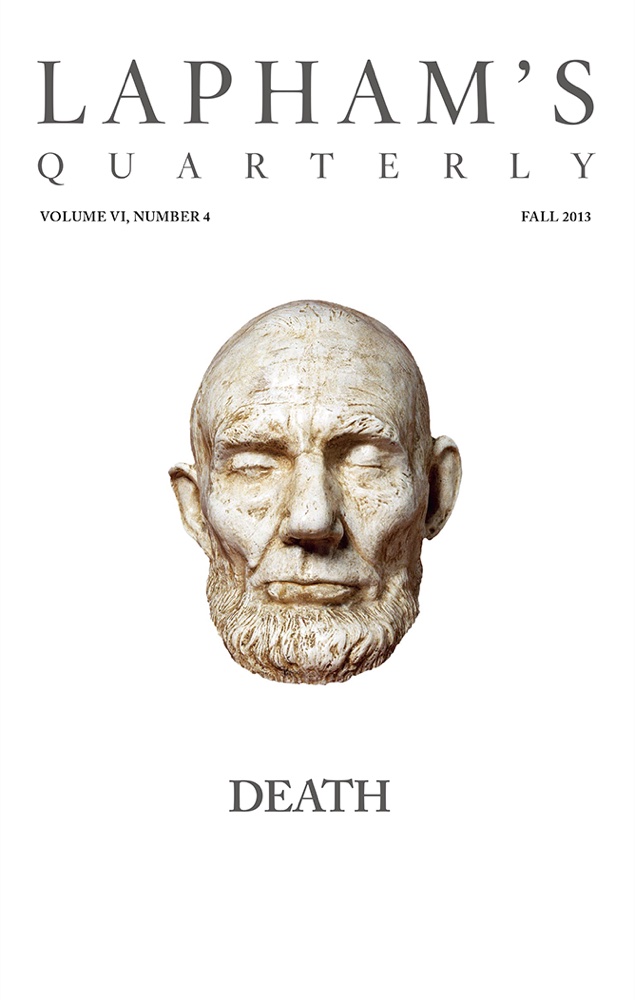
Cover of Lapham's Quarterly: Death

Lapham's Quarterly: Death

3rd century BCE – 21st century

4 ideas

Buy on Amazon

A themed issue of Lapham's Quarterly that gathers writings from many eras on death: learning to die, grief, memory and the afterlife of the dead, and the corpse as an object of study.

  1. Learning To Die Ends Servitude

    Confronting and accepting one's mortality is the precondition for freedom, because the fear of death is the lever by which one becomes a slave to power, convention, or self-deception. To learn how to die is therefore to unlearn how to be dominated.

  2. Grief Is Not Uniquely Human

    While humans may be alone in intellectually understanding that they will die, the emotional response to loss — mourning, distress at a companion's death — appears across many animal species. Grieving behavior is thus decoupled from conceptual awareness of mortality.

  3. The Dead Live In Recollection

    A person's continued existence after death consists entirely in being remembered by the living. Immortality is not metaphysical but social — sustained only as long as others cherish the memory.

  4. The Body As Studied Object After Death

    Viewing the corpse not as a sacred remnant but as material undergoing observable decay reframes death as a physical process open to scientific examination. This lens converts the taboo of the dead body into a source of usable knowledge.

Save ideas and give them a thumbs up or down in the app