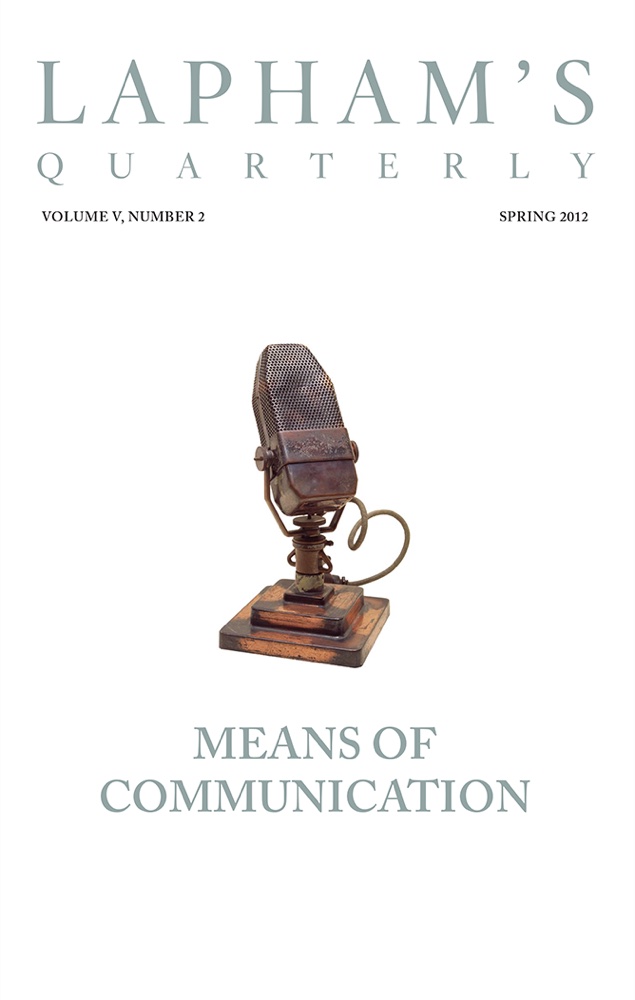
Cover of Lapham's Quarterly: Communication

Lapham's Quarterly: Communication

Lewis H. Lapham (ed.)

4 ideas

  1. Technology Cannot Displace the Primacy of Words

    Digital tools multiply the speed and reach of transmission but do not improve the underlying craft of language itself — the ability to compose meaning remains a human skill unimproved by faster pipes. Mistaking better distribution for better communication confuses volume with substance.

  2. History Takes Place Inside Language

    Language is not a neutral vehicle that events pass through; historical reality is constituted and structured by the words available to describe it. What can be thought, recorded, and acted upon is bounded by the linguistic forms a culture possesses.

  3. Fluency As Local Membership Test

    Speaking 'like a New Yorker' — mastering the idioms, cadence, and slang of a specific place — functions as a marker of belonging rather than mere clarity of communication. Dialect operates as a gatekeeping credential that signals insider status independent of the literal information conveyed.

  4. Media Saturation Manufactures Political Personas

    When a public figure achieves total media presence, the resulting image is a constructed pop-culture product rather than a reflection of the person or their record. Constant exposure does not inform the audience so much as shape a manageable, marketable identity.

Save and mark ideas in the app