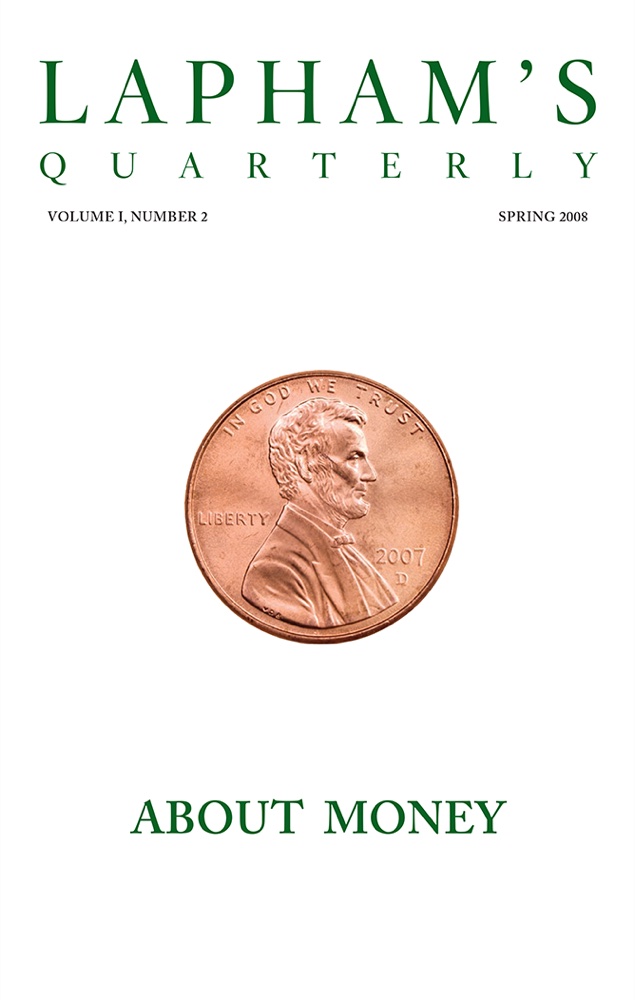
Cover of Lapham's Quarterly: About Money

Lapham's Quarterly: About Money

Lewis H. Lapham (ed.)

4 ideas

  1. The Undecided Question of Money's Nature

    Money's status as either mortal or immortal — a temporary means to human ends or a permanent end in itself — has never been resolved, and a nation's character depends on which assumption it operates under. Cultures built around the dream of riches tend to treat wealth as immortal, quietly converting a tool into a deity.

  2. The Man Who Dies Rich Dies Disgraced

    Andrew Carnegie argued that the accumulator of great wealth holds it only as a trustee obligated to distribute it during his lifetime, so that dying with a fortune intact is a moral failure. This reframes philanthropy not as generosity but as a debt the wealthy owe society for having been permitted to concentrate its surplus.

  3. Making Money Productive Versus Hoarding It

    Gold and silver held idle are dead capital; their value is realized only when put into circulation and made to reproduce through investment and lending. The mechanism treats money as livestock — something that must be bred and worked rather than stored.

  4. Finance as Sacred Order

    When money becomes 'the god of our times,' the institutions and figures that control its flow — banks, financiers — occupy the structural role once held by religion and its prophets. Viewing an era's dominant financial powers as its de facto priesthood reveals where a society actually locates ultimate authority, regardless of its stated beliefs.

Save and mark ideas in the app