Innumeracy as mathematical illiteracy
Paulos names the widespread inability to reason with numbers, probability, and scale. Like illiteracy, it distorts everyday judgment.
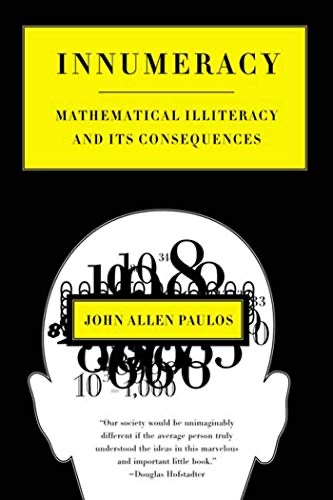
8 ideas
Paulos names the widespread inability to reason with numbers, probability, and scale. Like illiteracy, it distorts everyday judgment.
People who cannot estimate odds fall for astrology, quackery, and conspiracy. Numeracy is framed as a defense against being fooled.
Selective reporting and self-selection make claims look stronger than the data warrant. Correcting for how numbers are filtered is essential to sound reasoning.
When a condition is rare, even a highly accurate test can give more false positives than true positives. Ignoring the base rate makes people overreact to screening results, security flags and profiling.
A con artist mails 32,000 people a free stock tip, telling half that a stock will rise and half that it will fall. Each week he writes only to the half who got the correct call and splits them again. After six weeks about 500 people have seen six straight correct predictions, and many will pay for the seventh, not knowing about the thousands of failed letters that made the perfect record inevitable.
With enough people, days and possible matches, events that seem astronomically unlikely become nearly certain to happen to someone. For example, only 23 people are needed for better-than-even odds that two share a birthday, because the number of possible pairs grows much faster than the number of people. People mistake the chance that a specific coincidence happens to them for the chance that some coincidence happens to anyone, so they read meaning into what is just the arithmetic of large numbers.
Innumerate people treat a million, a billion and a trillion as the same vague 'a lot,' so they cannot rank costs, risks or claims correctly. Quick order-of-magnitude estimates put vague figures into a comparable scale. One such estimate shows that each breath you take probably contains a molecule from Julius Caesar's last breath, which exposes both how large and how small things really are.
People fear dramatic, publicized dangers like terrorism, kidnapping or plane crashes while shrugging off far deadlier routine risks like driving or smoking, because they judge risk by vividness rather than frequency. Personal and public resources then flow toward the wrong threats.