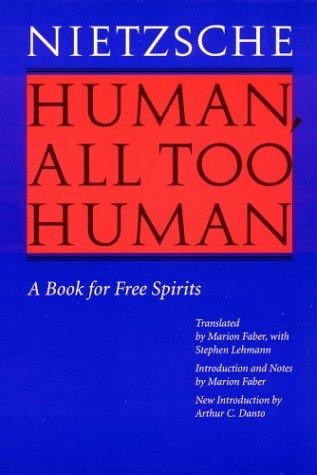
Cover of Human, All Too Human: A Book for Free Spirits

Human, All Too Human: A Book for Free Spirits

Friedrich Nietzsche

9 ideas

  1. Moral Values Have a History, Not an Origin

    What we call 'good' and 'evil' are not eternal truths but the residue of past judgments about what was useful or harmful to the group, later detached from their origins and treated as absolute. Tracing the genealogy of a moral feeling dissolves its supposed timelessness and reveals it as a contingent human invention.

  2. The Free Spirit

    The free spirit is one who has detached from inherited beliefs, customs, and communal expectations, judging according to its own reason rather than tradition. This detachment is achieved not by rebellion but by the slow erosion of certainty, leaving the thinker solitary but capable of seeing convention from the outside.

  3. Metaphysics as Misread Error

    Belief in a 'true world' beyond appearances arises from logical and grammatical errors, dreams, and the human craving for permanence, not from any access to a higher reality. The supposed metaphysical realm is a projection of psychological needs, so questions about it can be replaced by questions about why humans need to believe in it.

  4. Conviction as Enemy of Truth

    Strong convictions are more dangerous to truth than lies, because the convinced person stops examining and treats a belief as settled regardless of evidence. The capacity to hold positions provisionally and revise them is therefore a higher intellectual achievement than firm faith.

  5. The cult of genius protects vanity

    Audiences believe in sudden inspiration and innate genius because the finished work hides the long labor of selecting, rejecting and revising that produced it. Calling someone a genius is also self-flattering. If the artist is miraculous, we do not have to compare ourselves with them or feel smaller for not having done the work, because 'we do not suffer from what is superhuman.'

  6. The chemistry of moral and aesthetic sentiments

    Things people treat as opposites and as having higher origins, such as reason and unreason, altruism and egoism, or truth and error, are better explained as developing out of their supposed contraries. A 'historical philosophy' breaks the valued sentiment down, the way chemistry breaks down a compound, until it finds the base materials of fear, vanity and self-interest it grew from. The 'miraculous source' is usually just a failure to trace that history.

  7. Unselfish acts are redirected self-love

    No act is purely unegoistic. The soldier who dies for his country and the mother who gives up sleep for her child each love something in themselves, such as an idea, a longing or a creation, more than some other part of themselves. Self-sacrifice divides the self and sacrifices one part of it to another, and morality calls this selflessness only because it overlooks the split.

  8. Seeking pity is a bid for power

    Sufferers and children who cry to be pitied are not only asking for comfort. They want to confirm that, despite their weakness, they still have the power to hurt other people. Displaying misfortune gives them a small feeling of superiority over the healthy, who are made to feel pain on their behalf.

  9. Parsifal and Human, All Too Human cross

    Nietzsche later described the two books as crossing in the mail like 'crossed swords.' His book was dedicated to Voltaire, not Wagner, and dropped all metaphysical consolation, so the exchange ended the friendship and marked his public break with Wagner and Schopenhauer.

Save and mark ideas in the app