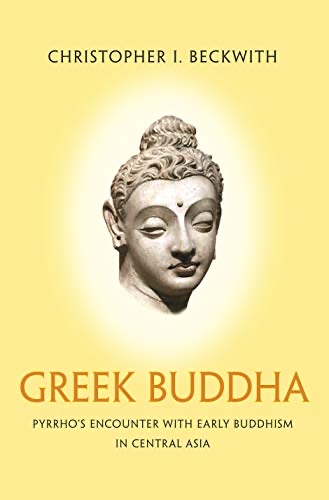
Cover of Greek Buddha

Greek Buddha

Christopher I. Beckwith

6 ideas

  1. Pyrrho Imported Buddhist Thought from India

    Pyrrho traveled to Central Asia and India with Alexander's army, encountered Buddhist teachings, and brought a version of them back to Greece. His distinctive philosophy is best explained as a Greek reworking of early Buddhist ideas rather than a purely native Greek development.

  2. Three Marks Mapped onto Pyrrho's Aristocles Passage

    Pyrrho's surviving teaching states that things (pragmata) are equally undifferentiated, unstable, and unjudgeable — a triad that directly parallels the early Buddhist three characteristics of existence (anitya, duḥkha, anātman). Reading the Aristocles passage through this triad reveals it as a doctrinal statement about the nature of phenomena, not merely an epistemological stance.

  3. Adiaphora as the Buddhist 'No Self-Nature'

    Pyrrho's claim that matters are adiaphora — without inherent differentiation or fixed essence — corresponds to the Buddhist denial that things possess a stable, self-defining nature. The Greek term should be read as a translation of a metaphysical position about the emptiness of fixed identity, not as ethical indifference.

  4. Reading Ancient Texts Through Loanword Traces

    Distinctive technical terms, names, and phrasings can carry fingerprints of a foreign source language even after translation. Tracking these linguistic residues across cultures lets you reconstruct contact and borrowing that the explicit historical record omits.

  5. Early Buddhism Was Not Originally About Rebirth

    The earliest recoverable Buddhist teaching centered on the analysis of phenomena and the achievement of calm, with elaborate karma-and-rebirth cosmology being a later accretion shaped by the surrounding religious environment. Stripping away the later layers yields a leaner, more philosophical core consistent with what Pyrrho would have encountered.

  6. Ataraxia as the Telos of Suspended Judgment

    When one stops asserting that things are inherently this or that, the result is a settled, untroubled state — ataraxia — which functions as the practical goal of the whole approach. The freedom from disturbance follows mechanically from withholding fixed judgments about the nature of things, mirroring the Buddhist link between non-grasping and peace.

Save and mark ideas in the app