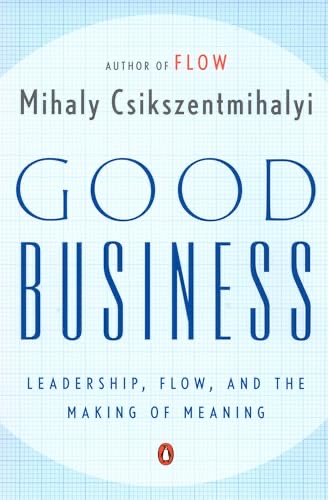
Cover of Good Business

Good Business

Mihaly Csikszentmihalyi

6 ideas

  1. Flow as Optimal Work Experience

    Flow is the state of complete absorption that occurs when a person's skills are matched to a challenge that stretches but does not overwhelm them, producing intense focus and intrinsic enjoyment. Work designed with clear goals, immediate feedback, and an appropriate difficulty level can reliably generate this state, making the activity rewarding regardless of external payoff.

  2. Profit Is a Means, Not the Goal

    A business that treats profit as its ultimate purpose will eventually fail to inspire the people it depends on, because money alone cannot supply meaning. Truly successful enterprises pursue a vision of contributing to the larger society, and treat profit as the resource that enables that contribution rather than the reason for existing.

  3. Building a Flow-Producing Workplace

    Organizations create conditions for flow by establishing clear goals, providing rapid feedback on performance, matching task difficulty to worker skill, and granting enough autonomy for workers to feel in control. When these elements are present, employees become engaged and productive without needing external pressure or surveillance.

  4. Soul of Business as Trust

    The 'soul' of a good business is the web of trust and mutual respect connecting leaders, employees, customers, and community, which cannot be reduced to contracts or incentives. This relational fabric is what allows the organization to behave with integrity under pressure and survive crises that purely transactional firms do not.

  5. Work as a Source of Identity and Meaning

    Because most adults spend the majority of their waking lives working, the quality of that experience determines a large share of overall life satisfaction and self-development. Viewing work not as a necessary burden but as a primary arena for growth reframes job design as a moral and psychological responsibility, not merely an economic one.

  6. Leaders Develop Through Complexity and Caring

    Effective business leaders evolve by integrating two normally opposing traits: differentiation (ambition, drive, individuality) and integration (empathy, concern for the whole). Leadership maturity is measured by the ability to hold these tensions together, caring for the welfare of others while still pursuing demanding goals.

Save and mark ideas in the app