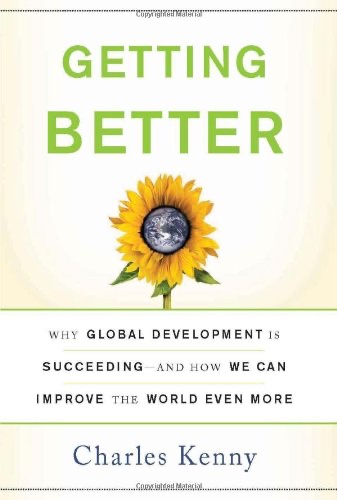
Cover of Getting Better: Why Global Development Is Succeeding

Getting Better: Why Global Development Is Succeeding

Charles Kenny

6 ideas

  1. Quality of Life Improves Despite Stagnant Income

    Many poor countries have seen dramatic gains in life expectancy, literacy, child survival, and education even where GDP per capita has barely moved or declined. This means human welfare and economic growth can decouple, so development success should not be measured by income alone.

  2. Cheap Technology Diffusion Drives Welfare Gains

    Low-cost innovations like vaccines, antibiotics, oral rehydration therapy, and bed nets spread across borders independently of a country's wealth or institutions. Because these technologies are inexpensive to adopt, they deliver large health and survival improvements even in stagnant economies.

  3. Ideas Spread Faster Than Income

    Knowledge and norms — about hygiene, the value of schooling, the rights of women, and the desirability of fewer children — diffuse globally much more easily than capital or productive capacity. The cross-border movement of ideas explains why behavior and outcomes converge while incomes stay divergent.

  4. Measure Outcomes Not Inputs or Income

    Judging development by what people can actually do and be — survive childhood, read, live longer — reveals progress invisible when looking only at money. This shift reframes 'failed' economies as places that have nonetheless succeeded enormously on the things that matter to lives.

  5. Growth Causes Resist Policy Manipulation

    Decades of attempts to engineer economic growth through aid, structural reforms, or institutional prescriptions have produced no reliable formula, because the drivers of income growth remain poorly understood and context-dependent. By contrast, the determinants of health and education gains are clearer and more directly actionable.

  6. Redirect Aid Toward Proven Welfare Wins

    Since aid struggles to manufacture growth but reliably improves health and education when targeted at specific interventions, development assistance should focus on delivering measurable quality-of-life outcomes rather than chasing GDP acceleration. This means funding vaccines, schools, and disease control over speculative growth strategies.

Save and mark ideas in the app