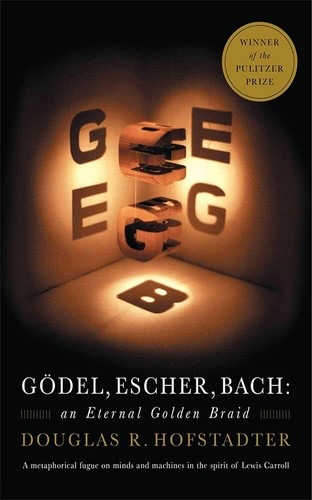
Cover of Gödel, Escher, Bach

Gödel, Escher, Bach

Douglas Hofstadter

8 ideas

  1. Levels of Description Decouple From Substrate

    Complex phenomena can be described at multiple levels — hardware, machine code, program, meaning — where each higher level has its own laws that don't require knowing the level below. Understanding emerges from picking the right level, because high-level behavior is largely independent of the specific lower-level implementation carrying it.

  2. Formal Rules Can Generate Open-Ended Behavior

    A finite set of mechanical, deterministic rules operating on simple elements can produce structures of unbounded complexity and apparent creativity, as seen in recursive growth and self-replicating patterns. This dissolves the intuition that intelligence or novelty requires something beyond rule-following — richness comes from how rules compound, not from escaping them.

  3. The tortoise defeats every record player

    For each one it crafts a record whose vibrations will shatter that very player, and every sturdier or self-modifying player invites a new destructive record. The fable dramatizes Gödel's result: any system powerful enough to reproduce arbitrary content can be fed a self-targeting input it cannot handle.

  4. Gödel numbering lets arithmetic talk about itself

    Gödel assigned numbers to symbols, formulas and proofs, so statements about proofs become statements about numbers. He then built a sentence that says, in effect, 'This statement cannot be proven in this system.' If the system is consistent, the sentence is true but unprovable, so any sufficiently powerful consistent formal system is incomplete.

  5. Strange loops and tangled hierarchies

    A strange loop occurs when moving upward through the levels of a hierarchical system unexpectedly returns you to the starting level. Escher's Drawing Hands, Bach's endlessly rising canon, and Gödel's self-referential sentence all share this structure. Hofstadter argues that such tangles, where a system's top level reaches back down to affect its own base, are where selfhood lives.

  6. The self is a symbol modeling itself

    The brain builds active symbols for concepts in the world, and among them it builds a symbol that represents the brain itself. When that self-symbol feeds back into the processes that generate it, the result is an 'I': a loop that perceives itself as a causal agent. Consciousness is not an extra substance but this high-level self-referential pattern running on meaningless neural substrate.

  7. Meaning arises from isomorphism, not symbols

    Symbols in a formal system are meaningless shapes shuffled by rules. They gain meaning when their patterns of manipulation map faithfully (isomorphically) onto some other structure. Meaning is therefore not inside the tokens but in the correspondence a mind recognizes between two patterned systems.

  8. Levels of description in the ant colony

    An ant colony behaves purposefully even though no individual ant understands anything. Its intelligence can only be described at a higher level of signals and caste patterns, not at the level of single ants.

Save and mark ideas in the app