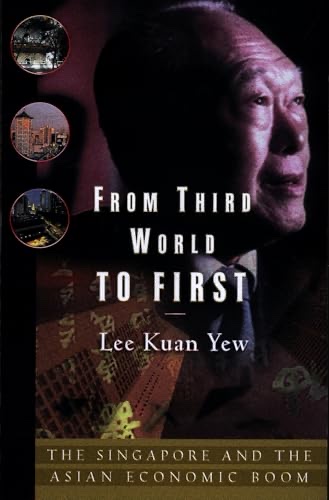
Cover of From Third World to First

From Third World to First

Lee Kuan Yew

8 ideas

  1. First World standards inside a poor region

    A small state surrounded by underdeveloped neighbors can attract investment not by competing on cheap labor but by becoming an island of reliability — clean streets, working infrastructure, enforced contracts, and honest officials. The differentiator is being the exception to regional dysfunction, so multinationals choose you for predictability rather than price.

  2. Survival forces meritocracy over patronage

    When a country has no natural resources and no hinterland, its only asset is the quality of its people, which makes selecting leaders and civil servants by ability rather than connection a survival necessity rather than a moral preference. Pay public officials wages competitive with the private sector so talent stays in government and corruption loses its rationale.

  3. Multiracialism as enforced equal footing

    Rather than letting a majority ethnic group dominate, the state deliberately guarantees each race equal standing in language, religion, and opportunity, and treats any communal favoritism as an existential threat. Social peace is engineered by removing the expectation that numerical majority confers political ownership.

  4. Greening Singapore to signal competence

    Planting trees and obsessively maintaining cleanliness across the city was treated not as cosmetic but as a strategic signal to visiting investors and officials that the government was effective and the workforce disciplined. The visible order of the physical environment was used as evidence of the invisible order of institutions.

  5. Leapfrog the region via multinationals

    With no hinterland, no natural resources, and a British military pullout announced in 1968, Singapore chose not to depend on trade with its hostile neighbours. It instead linked itself to the developed world by attracting Western and Japanese multinational manufacturers. It offered them order, infrastructure, a disciplined workforce and English as the working language, making first-world investors its economic hinterland.

  6. Pay ministers market rates against corruption

    Lee argued that ministers and senior civil servants should be paid close to what equally able people earn in the private sector. His reasoning was that underpaid officials either become corrupt or leave for business, so competitive pay is a cheaper safeguard than moral exhortation.

  7. Home ownership as a nation-building stake

    After separation in 1965, Singapore's Housing and Development Board built mass flats and sold them to their occupants rather than renting them. From 1968, citizens could use their compulsory Central Provident Fund savings for the down payments. Lee's stated reasoning was that citizens who own their homes have a tangible stake in the country's stability, and that conscripted soldiers will fight for a country where their families own property.

  8. Treating opponents' attacks as legal matters

    Lee openly describes suing opposition politicians for defamation and detaining alleged subversives without trial under the Internal Security Act. He frames these actions as defences of government integrity and public order, not as suppression of dissent.

Save and mark ideas in the app