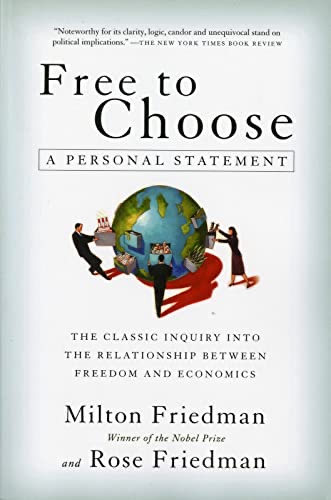
Cover of Free to Choose

Free to Choose

Milton Friedman, Rose D. Friedman

10 ideas

  1. The Price System as Information Network

    Prices simultaneously transmit information about relative scarcity, provide incentives to act on that information, and distribute income to those who produce. No central planner can replicate this because the knowledge needed is dispersed across millions of individuals and exists nowhere in aggregate form.

  2. Economic Freedom Precedes Political Freedom

    Political freedom cannot survive without economic freedom because concentrating economic power in the state removes the independent base from which dissent can be funded and organized. A free market disperses power and allows opponents of those in authority to support themselves.

  3. Regulation Captured by Those Regulated

    Agencies created to protect the public from an industry are eventually dominated by that industry, because the regulated parties have concentrated incentive and expertise to influence the regulators while the public's interest is diffuse. The result is barriers to entry and protection of incumbents rather than consumers.

  4. Helping the Poor Through Negative Income Tax

    Rather than a patchwork of welfare programs with overlapping bureaucracies and perverse incentives, a single cash transfer that supplements income below a threshold preserves the recipient's incentive to work because earning more never fully cancels the benefit. It gives aid in the universally useful form of money and lets recipients decide how to use it.

  5. Equality of outcome destroys liberty

    A society that puts equality of outcome ahead of freedom will get neither, because enforcing equal results requires coercion that concentrates power in those who administer it. A society that puts freedom first, including equality before the law and equality of opportunity, ends up with both greater liberty and greater equality as a by-product.

  6. The pencil nobody knows how to make

    Borrowing Leonard Read's essay, the Friedmans note that no single person knows how to make a pencil: loggers, graphite miners, rubber growers and metal workers across continents cooperate without knowing or liking one another. The price system transmits the information and incentives that coordinate them, so complex order emerges from voluntary exchange with no central direction.

  7. Inflation is always a monetary phenomenon

    Inflation occurs when the quantity of money grows faster than output. It is produced by governments and central banks, not by greedy businesses, unions or oil producers. Because it acts as a tax imposed without legislation, governments are tempted to cause it, and its cure, slower monetary growth, brings temporary unemployment as an unavoidable side effect.

  8. Four ways of spending money

    You can spend your own money on yourself, your own money on others, others' money on yourself, or others' money on others. Only in the first case are both economy and value carefully weighed. Government spending falls mostly into the fourth category, where neither cost nor results are closely watched, so waste and misdirection are built in.

  9. Education vouchers to create school choice

    Separating the financing of education from its administration would make schools compete for students. Parents would gain the market power the Friedmans argue wealthier families already exercise by choosing where to live.

  10. Concentrated benefits, diffuse costs

    Special-interest programs survive because their benefits fall on a small, organised group with a strong incentive to lobby, while their costs are spread thinly across millions of taxpayers or consumers who hardly notice them. Viewed this way, tariffs, licensing and subsidies persist regardless of their net harm, because political incentives reward the concentrated few.

Save and mark ideas in the app