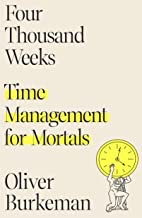
Cover of Four Thousand Weeks: Time Management for Mortals

Four Thousand Weeks: Time Management for Mortals

Oliver Burkeman

8 ideas

  1. The Finite Lifespan as Four Thousand Weeks

    A human life of roughly eighty years contains only about four thousand weeks, an absurdly and unsettlingly small number. Confronting this concrete figure replaces abstract notions of mortality with a forced reckoning that makes the scarcity of time impossible to ignore.

  2. Deciding by Embracing Necessary Neglect

    Because you can never do everything, choosing what to do means actively and permanently neglecting nearly all other options, not deferring them. Effective prioritization treats finitude as the precondition for meaningful commitment rather than a problem to be solved away.

  3. Time instrumentalized empties the present

    When every hour is treated as a means to a future payoff, the present becomes merely a route to somewhere else, and life keeps being deferred until some imagined point when things will finally be settled. That point never arrives, so a life lived this way never fully happens. Doing some things with no aim beyond the doing, such as hobbies you are bad at, counters this.

  4. Strategic underachievement across life domains

    Because you cannot excel at everything, you should decide in advance which areas of life you will let yourself do badly in, such as a messy house or unanswered minor email. Picking the failures on purpose frees attention for what matters and removes the guilt of failing by accident. The alternative is not excellence everywhere but mediocrity spread thin and chosen by default.

  5. Pay yourself first with time

    Borrowed from personal finance: give your most important project the first and best portion of each day before any reactive work. If you wait until obligations are cleared, that time never comes, because the obligations are endless. Combine this with limiting work in progress, such as a small fixed number of active projects, so that finishing is forced before starting.

  6. The efficiency trap expands the list

    Getting faster at handling tasks does not shrink your workload; it raises how much gets expected of you and draws in more commitments, so the pile grows to exceed your new capacity. Clearing email faster generates more email, and becoming known as reliable brings more requests. Productivity gains therefore feed the problem they were supposed to solve.

  7. Cosmic insignificance therapy

    Measured against the scale of the universe, your life and choices are tiny, and accepting this is freeing rather than bleak. It takes away the pressure to produce something remarkable or leave a legacy, which often paralyzes people. What remains is permission to do modest, good things well within the time you have.

  8. Busyness as avoidance of finitude

    Frantic productivity and constant distraction can be read as ways of dodging the discomfort of being a limited creature who must choose. Reaching for your phone or adding a task to a system brings relief because it postpones facing that you cannot do it all. Seeing distraction as flight from discomfort, not a failure of willpower, changes the remedy from better tools to tolerating the discomfort.

Save and mark ideas in the app