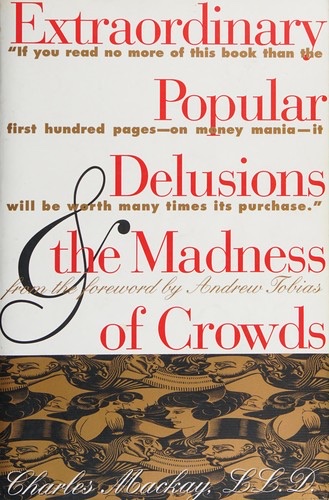
Cover of Extraordinary Popular Delusions and the Madness of Crowds

Extraordinary Popular Delusions and the Madness of Crowds

Charles Mackay

9 ideas

  1. Men Go Mad in Herds, Recover Singly

    Delusions spread through populations as a collective phenomenon where individuals lose independent judgment and adopt the surrounding frenzy. Recovery, however, happens one person at a time and slowly, as each individual gradually regains their senses long after the crowd has moved on.

  2. Speculative Mania Detached From Intrinsic Value

    A financial bubble forms when the price of an object becomes driven entirely by the expectation that someone else will pay more, rather than by any use or underlying worth. The asset's actual utility becomes irrelevant; only the belief in rising prices sustains the market until belief evaporates.

  3. Mississippi Scheme and Paper Wealth

    John Law's Mississippi Company in France convinced a nation to exchange gold for paper shares promising riches from undeveloped colonial land. The frenzy of buying inflated share prices to absurd heights before the realization that the underlying enterprise produced nothing triggered a ruinous national collapse.

  4. Mass Belief as Self-Reinforcing Reality

    When enough people act on a shared conviction — whether in alchemy, prophecy, or a stock — their collective behavior temporarily makes the belief appear true and profitable. The delusion sustains itself precisely because participation by the crowd generates the evidence the crowd cites to justify continuing.

  5. The Lifecycle of a Popular Delusion

    Delusions follow a recurring arc: a seductive promise attracts early adopters, success stories pull in the masses, frenzy peaks as skepticism vanishes, then a triggering doubt causes sudden collapse and recrimination. Studying past episodes reveals the same structure repeating across centuries with different objects of obsession.

  6. Tulipmania in the Dutch Republic, 1636–37

    In the 1630s Dutch buyers bid tulip bulbs, above all rare 'broken' varieties like Semper Augustus, up to prices Mackay says matched the value of a house or a large estate. Contracts for bulbs still in the ground were traded in taverns by people who never meant to plant them. When buyers stopped showing up in February 1637 prices collapsed within days, courts refused to enforce the contracts, and holders were ruined.

  7. Witch hunts grow through accusation incentives

    Mackay shows European witch persecutions growing because of how they were run. Torture produced confessions that named further accomplices, accusers and officials gained property or status, and doubting the charge could make the doubter a suspect. Once the system rewarded accusing and punished skepticism, the belief multiplied its own evidence. It faded only when courts and authorities stopped accepting that evidence.

  8. Rising prices recruit the skeptics

    In each bubble Mackay describes, sober people first dismiss the mania. Then they watch neighbors grow rich and join in near the top, because the pain of missing out outweighs their doubts. The price rise itself becomes the argument for buying, so the mania feeds itself until the supply of new buyers runs out.

  9. The South Sea Bubble and its bubble companies

    In 1720 the South Sea Company took over British government debt in exchange for trading privileges it barely used, and its stock rose from about £128 to over £1,000 on promotion and insider-favored subscription schemes. Copycat 'bubble' companies sprang up, including one advertised as 'for carrying on an undertaking of great advantage, but nobody to know what it is.' The collapse that autumn ruined many investors and exposed bribery of ministers.

Save and mark ideas in the app