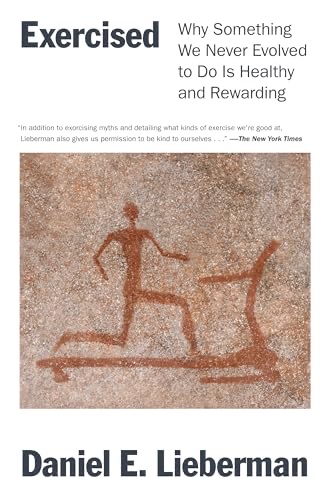
Cover of Exercised

Exercised

Daniel E. Lieberman

6 ideas

  1. Humans Evolved to Avoid Unnecessary Exertion

    Because calories were scarce throughout human evolution, natural selection favored instincts to rest and conserve energy whenever physical activity was not required for survival or reproduction. The modern guilt about being lazy is misplaced — avoiding pointless exercise was adaptive, which is why willpower alone rarely overcomes the deep-seated urge to sit down.

  2. Active Grandparent Hypothesis

    Sustained physical activity into older age repairs and maintains the body by triggering cellular maintenance and repair processes that are otherwise dormant. Humans evolved long post-reproductive lifespans partly because active elders foraged and provisioned grandchildren, meaning the body is built to stay healthy through continued movement rather than rest.

  3. Humans As Endurance Running Specialists

    Distinct anatomical features — springy Achilles tendons, sweat glands instead of fur, large gluteal muscles, and a nuchal ligament stabilizing the head — show humans evolved for long-distance running, not sprinting. Our ancestors used persistence hunting, jogging prey to heat exhaustion over hours, a uniquely human capacity among primates.

  4. Exercise As Evolutionary Mismatch

    Formal 'exercise' is a recent invention required only because modern environments removed the physical activity that survival once demanded. Treating workouts as abnormal and effortful reframes the problem: we are not failing at a natural duty but compensating for a world that engineered movement out of daily life.

  5. Inactivity Diverts Energy Toward Harmful Processes

    Energy not spent on physical activity does not simply disappear but gets allocated to reproduction-related and inflammatory processes that, in excess, drive chronic diseases like type 2 diabetes, heart disease, and certain cancers. Physical activity protects health partly by redirecting metabolic energy away from these damaging pathways.

  6. Make Exercise Necessary Or Fun To Sustain It

    Since humans are evolutionarily wired to avoid optional exertion, willpower-based exercise plans tend to fail. The reliable levers are social commitment, making activity unavoidable through routine and obligation, and choosing forms of movement that are genuinely enjoyable — engaging the same motivators (reward, social bonding) that drove ancestral activity.

Save and mark ideas in the app