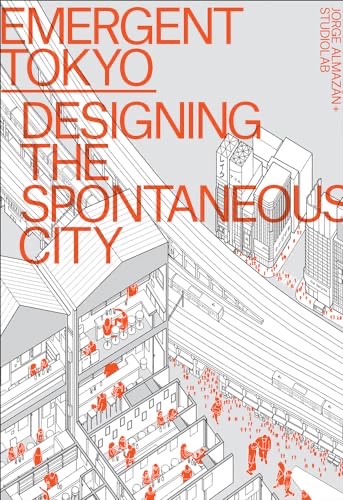
Cover of Emergent Tokyo

Emergent Tokyo

Jorge Almazán and StudioLab

6 ideas

  1. Emergence Versus Top-Down Urban Planning

    Vibrant urban character can arise from the uncoordinated decisions of countless individual actors operating under shared constraints, rather than from a master plan imposed by a central authority. The resulting form is legible and coherent even though no one designed it, because the constraints channel independent choices into recognizable patterns.

  2. Yokocho As Micro-Scale Density Engine

    Tightly packed alleyways of tiny bars and eateries generate intense social life by squeezing many independent businesses into a small footprint, where each operator can survive on a handful of seats. The narrowness forces proximity and spillover between strangers and shops, manufacturing conviviality as a byproduct of physical compression.

  3. Fine-Grained Land Ownership Enables Diversity

    When land is divided into many small parcels held by many separate owners, redevelopment happens incrementally and at small scale, preserving variety and resisting homogenization. Large consolidated plots, by contrast, invite single uniform megaprojects that erase the mix of uses and scales that makes streets lively.

  4. Reading Cities Through Negotiated Boundaries

    Look at the threshold zones where private interiors leak into public streets — the displayed goods, seating, and signage that spill past the building line. These ambiguous in-between spaces, neither fully private nor public, are where urban vitality is actually produced and negotiated rather than in the formally designated plazas.

  5. Zakkyo Buildings As Vertical Streets

    Mid-rise buildings stacked with independent tenants on every floor — each advertised by its own protruding signboard — turn vertical circulation into a browsable commercial corridor. The dense layering of unrelated small businesses in one structure replicates the variety of a street in the vertical dimension.

  6. Designing For Emergence, Not Outcomes

    Planners should set the enabling conditions — small parcels, permissive use rules, narrow streets, tolerance of informal occupation — and let desirable urban form arise rather than specifying the final result. The role shifts from designing buildings to designing the rules and constraints within which countless actors make their own decisions.

Save and mark ideas in the app