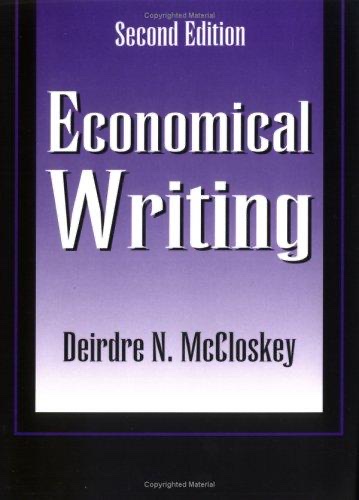
Cover of Economical Writing

Economical Writing

Deirdre McCloskey

6 ideas

  1. Clear Writing Reveals Clear Thinking

    Bad prose is not a surface defect to be polished after the thinking is done — it is direct evidence of muddled thought. Because writing and thinking are the same act, fixing the sentence forces you to actually figure out what you mean.

  2. Elegance Through Cutting, Not Adding

    Economical writing means removing every word that does not earn its place, especially throat-clearing qualifiers, redundant phrases, and inflated abstractions. The goal is not brevity for its own sake but density — each remaining word carrying real weight.

  3. Write For A Real Reader

    Choose a specific imagined reader — intelligent but uninformed about your topic — and write everything to serve their understanding rather than to impress your peers or prove your credentials. Jargon, hedging, and self-display all betray that you are writing for status instead of communication.

  4. Writing is thinking, not decoration

    McCloskey argues clear writing reflects clear thought, so muddy prose signals muddy reasoning rather than mere style. Improving the sentence forces you to sharpen the idea.

  5. Cut, concrete, and active

    The core rules are to cut needless words, prefer concrete detail over abstraction, and write in the active voice with strong verbs. Economy of words earns the reader's trust and attention.

  6. Write for a reader, persuade

    Prose is a rhetorical act aimed at convincing a real reader, not a neutral transfer of information. Anticipating the reader's resistance shapes what and how much you say.

Save and mark ideas in the app