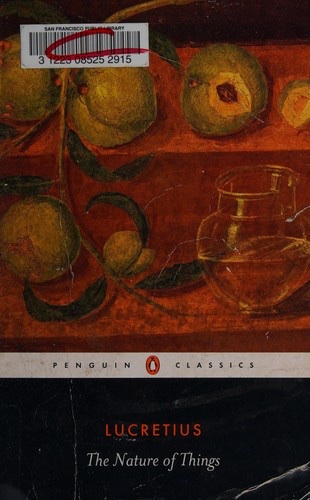
Cover of De Rerum Natura (The Nature of Things)

De Rerum Natura (The Nature of Things)

Lucretius

10 ideas

  1. Nothing Comes From Nothing

    Matter is never created from non-being nor destroyed into nothing; if things could arise from nothing, any species could spring from any source without seeds or seasons. Because growth requires specific materials and time, there must be permanent, conserved building blocks underlying all change.

  2. Indivisible Atoms and Void

    Reality consists of only two ultimate things: solid, indestructible particles too small to divide further, and the empty space through which they move. All apparent qualities and objects are arrangements and motions of these atoms in void, not new substances.

  3. Fear of Death Is Irrational

    Since the soul is itself made of atoms that disperse at death, no perceiving self survives to experience suffering or loss. Death is therefore 'nothing to us' — the state of non-existence after death is identical to the non-existence before birth, and neither should be feared.

  4. Religion as Source of Cruelty

    Belief in interfering gods and divine punishment, not piety, drives humans to monstrous acts and chronic anxiety. Viewing natural events as having physical causes rather than divine will removes the terror that priests and superstition exploit.

  5. The Sacrifice of Iphigenia

    Agamemnon's daughter is led to the altar believing she goes to marriage, only to be slaughtered to win favorable winds for the fleet. The episode is offered as proof that religious belief can compel parents to kill their own children — 'so great are the evils that religion could prompt.'

  6. Honey on the cup's rim

    Lucretius describes his verse as honey smeared on the rim of a cup of bitter wormwood that a doctor gives a child. The pleasing form gets a hard, unwelcome truth swallowed before the reader resists. Persuasion works by making the medicine palatable, not by diluting it.

  7. The swerve breaks deterministic causal chains

    Atoms falling through the void occasionally deviate by a minimal, unpredictable amount at no fixed time or place. This clinamen is what makes atomic collisions, and so worlds, possible. It is also what breaks the chain of fate, giving living beings a physical basis for free will.

  8. Natural causes dissolve religious terror

    Thunder, earthquakes, eclipses and disease are explained as the mechanical results of atoms moving in void, not as signs of divine anger. Once a phenomenon has a sufficient physical cause, the fear built on reading it as punishment loses its footing. Where several natural explanations fit, it is enough that any of them could be true, because the aim is peace of mind rather than certainty.

  9. Athenian plague as unconsoled ending

    The poem ends on Thucydides' plague at Athens, made more graphic: bodies rot in temples, and mourners brawl over funeral pyres to burn their own dead on them. Piety, medicine and social bonds all collapse, and the gods do nothing. By closing on catastrophe with no consolation, the poem pushes the reader to apply its doctrine in the worst case, or to see how people who lack it are destroyed by terror.

  10. Symmetry argument from prenatal nonexistence

    The endless time before our birth is a mirror held up to the time after our death. We felt no distress at not existing before we were born, so the same absence after death should hold no terror. The past is used as evidence for how the future will feel, or rather not feel.

Save and mark ideas in the app