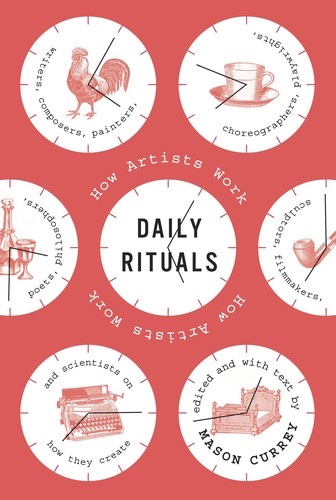
Cover of Daily Rituals

Daily Rituals

Mason Currey

5 ideas

  1. Routine Conserves Willpower for Creative Work

    A fixed daily schedule removes the need to decide when and how to work, freeing limited mental energy for the actual creative output rather than the logistics around it. The ritual itself becomes automatic, so decision fatigue never touches the work that matters.

  2. The Productive Constraint of Day Jobs

    Many prolific creators worked within rigid external constraints — jobs, family duties, fixed hours — and these limits sharpened rather than smothered their output. The scarcity of free time forced disciplined use of small, protected windows instead of relying on open-ended leisure.

  3. Walking as Cognitive Incubation

    Long daily walks recur across creators as a deliberate tool: physical movement at a steady pace loosens fixed thinking and lets unresolved problems reorganize below conscious effort. The walk is scheduled work, not a break from work — incubation happens precisely because the mind is occupied elsewhere.

  4. Vices as Functional Machinery, Not Flaws

    Stimulants, alcohol, isolation, and odd compulsions are examined as operational components of a working life rather than moral failings or romantic flourishes. Each crutch is read by what it actually does — managing anxiety, forcing focus, or marking the transition into the working state.

  5. Maya Angelou's Rented Hotel Room Ritual

    Among the book's roughly 160 short profiles, Maya Angelou kept a small, bare hotel room in her hometown, with pictures removed from the walls, purely for writing. She arrived around 6:30 a.m. with a dictionary, a Bible, a thesaurus, a deck of cards and a bottle of sherry, wrote lying across the bed on yellow legal pads, and left by early afternoon. She then went home to shower and cook, and read over the day's pages in the evening.

Save and mark ideas in the app