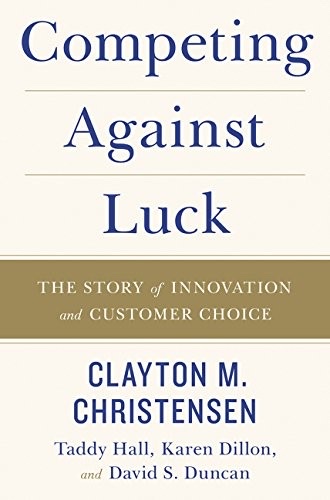
Cover of Competing Against Luck

Competing Against Luck

Clayton M. Christensen, Taddy Hall, Karen Dillon, David S. Duncan

6 ideas

  1. Customers Hire Products to Do Jobs

    People don't buy products; they 'hire' them to make progress in a specific circumstance. The 'job' is the progress a person is trying to make, including its functional, social, and emotional dimensions, and the same product can be hired for entirely different jobs.

  2. Milkshakes Hired for the Morning Commute

    A fast-food chain studied who bought milkshakes and found many were purchased early morning by solo commuters who needed something to occupy a long, boring drive and stave off hunger until lunch. Improving the shake meant making it thicker and more interesting to sip through a straw — not making it tastier — because the real job was surviving the commute.

  3. Correlation Data Misleads Innovators

    Mountains of customer data showing what attributes correlate with purchases reveal nothing about why people buy, creating an illusion of understanding. Knowing that 64-year-old fathers buy a product tells you nothing about the causal mechanism driving the purchase, so innovation built on correlation is a gamble.

  4. Map the Forces of Progress

    A customer's switch to a new solution is governed by four forces: the push of the current situation and the pull of the new option drive change, while habit of the present and anxiety about the new resist it. Innovators must both strengthen the attracting forces and actively neutralize the resisting ones to win a customer.

  5. Competition Is Defined by the Job

    Your real competitors are anything a customer could hire to make the same progress, including doing nothing at all — not just products in your industry category. A company sees its true competitive set only by looking through the lens of the job rather than the product type.

  6. Organizations Drift Toward Their Own Metrics

    As companies scale, they shift their focus from the customer's job to internal processes and the data those processes generate, optimizing for their own efficiency rather than customer progress. Without structures that keep the job central, firms unconsciously substitute 'what's good for us' for 'what gets the customer's job done.'

Save and mark ideas in the app