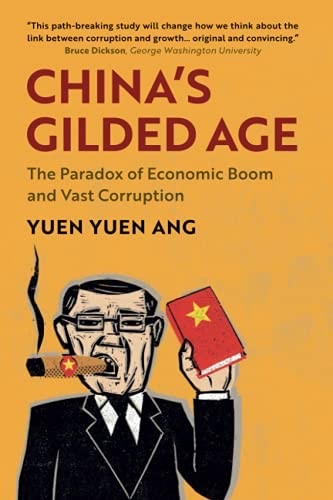
Cover of China's Gilded Age

China's Gilded Age

Yuen Yuen Ang

6 ideas

  1. The Four Varieties of Corruption Typology

    Corruption splits along two axes: whether it involves elite or non-elite actors, and whether money exchanges with or without theft. This yields petty theft, grand theft, speed money, and access money — each with distinct economic effects, so lumping them into one 'corruption' metric obscures more than it reveals.

  2. Access Money as Steroids

    Access money — elite exchanges where capitalists pay officials for privileges and deals rather than to overcome theft — functions like steroids for an economy: it can fuel rapid growth in the short term while accumulating serious distortions and risks underneath. Unlike petty bribery, it doesn't visibly drag down output, which is why high-growth economies can be deeply corrupt.

  3. Corruption Structure Evolves With Development

    As economies develop, the dominant form of corruption shifts from petty theft and speed money toward access money, even as crude bribery declines. This means aggregate corruption indices can show 'improvement' while the most growth-distorting elite form actually intensifies.

  4. Profit-Sharing Through Bureaucratic Compensation

    Chinese local officials were partly compensated through a share of the revenue and growth they generated, turning bureaucrats into stakeholders in local business success. This aligned official incentives with capitalist expansion, converting potential predation into a partnership that drove development while embedding access money.

  5. America and China as Corrupt Mirrors

    Viewing legalized lobbying, revolving doors, and campaign finance as functionally equivalent to access money reveals that wealthy democracies haven't eliminated corruption but rather legalized and institutionalized its elite-exchange form. The difference between China and the US is less about the presence of access money than about its legal packaging.

  6. Corruption Measured by Quality Not Quantity

    Standard indices rank countries by a single perceived-corruption score, but this collapses qualitatively different practices into one number. Disaggregating by type — measuring the composition rather than the volume of corruption — explains why some corrupt countries thrive and others collapse.

Save and mark ideas in the app