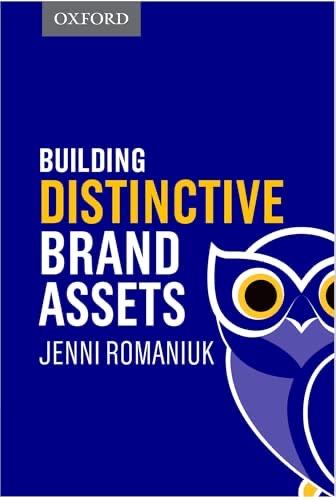
Cover of Building Distinctive Brand Assets

Building Distinctive Brand Assets

Jenni Romaniuk

6 ideas

  1. Distinctive Assets vs Differentiation

    Distinctive assets are non-verbal brand elements (colors, logos, characters, shapes, sounds) that trigger the brand in memory without communicating any benefit or point of difference. Their job is identification — getting the brand noticed and correctly attributed — not persuasion, which separates them from messaging strategy entirely.

  2. The Fame-Uniqueness Grid

    Every potential distinctive asset is scored on two axes: Fame (the percentage of category buyers who link the asset to the brand) and Uniqueness (the percentage who link it to your brand alone versus competitors). Assets fall into four zones — Avoid, Test/Investment, Usable, and Solid — which dictate whether to drop, build, deploy, or protect each one.

  3. Assets Are Built Through Repetition Not Reinvention

    Distinctive assets gain mental availability only through consistent, high-frequency exposure over years, because memory links strengthen with repetition and decay without it. Constant rebranding or creative refreshes destroy accumulated asset value, making consistency a strategic asset rather than a creative compromise.

  4. Co-Presentation Builds Asset Memory

    A distinctive asset becomes linked to a brand only when the two are repeatedly shown together, so that the asset can eventually evoke the brand on its own. Removing the brand name too early — before the link is strong — wastes the asset because audiences fail to make the connection.

  5. Brand Elements As Memory Shortcuts

    View every visual and sensory brand element as a retrieval cue competing for a slot in the buyer's memory, not as decoration or aesthetic preference. This reframes design decisions around 'will this trigger our brand at the point of purchase?' rather than 'is this attractive or on-trend?'

  6. Asset Portfolio Risk Management

    Brands should hold a portfolio of multiple distinctive assets rather than relying on a single one, spreading risk across formats and touchpoints where different assets perform best. This allows graceful evolution — strong assets can carry the brand while weaker or newer ones are tested and built without exposing the brand to identification gaps.

Save and mark ideas in the app