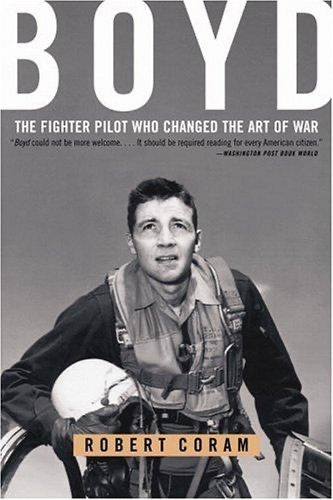
Cover of Boyd

Boyd

Robert Coram

5 ideas

  1. Forty-Second Boyd's Standing Bet

    As a fighter instructor, Boyd offered to start any opponent on his tail and reverse the position within forty seconds or pay forty dollars, and he never lost. The wager demonstrates how superior understanding of the underlying mechanics — not just raw skill — lets one person reliably dominate by anticipating and exploiting predictable reactions.

  2. Boyd's Fighter Mafia forces the F-16

    In the late 1960s and 1970s, Boyd was a Pentagon officer who had used E-M theory to show that the heavy F-15 design was overweight. He then worked with a small group, including Pierre Sprey and Everest Riccioni, on a cheap, light, highly manoeuvrable fighter. The Air Force leadership opposed it as a threat to the F-15, so the group kept the work alive partly under cover as a 'study' and got support from Deputy Secretary of Defense David Packard's prototype fly-off programme. Boyd himself stalled at colonel and was never promoted to general.

  3. Energy-manoeuvrability theory quantifies fighter performance

    A fighter's combat capability can be expressed as specific excess power: (thrust minus drag) times velocity, divided by weight. This tells you how fast an aircraft can gain or lose energy at any altitude, speed and g-load. Plotting these curves for two aircraft shows exactly where in the flight envelope each one beats the other, which turns dogfighting from pilot folklore into an engineering comparison that can drive both tactics and design.

  4. To be somebody or to do something

    Boyd told his protégés that they would reach a fork in the road. One path is to go along with the institution to get promoted and become somebody. The other is to do what is right and accomplish something, knowing this may cost you your career. Seen this way, organisational rewards and real contribution can come apart: bureaucracies often punish the people who produce their most important results, so career success cannot be taken as a measure of impact.

  5. OODA loop and operating inside the decision cycle

    Every combatant repeatedly cycles through Observe, Orient, Decide, Act, and Orientation (the filter of culture, experience and mental models) is the step that shapes all the others. The side that cycles faster and less predictably changes the situation before the opponent has finished reacting to its last move. The opponent's picture then goes stale and his actions stop fitting reality, and eventually he becomes confused and paralysed. The goal is to collapse his capacity to adapt, not to destroy him piece by piece.

Save and mark ideas in the app