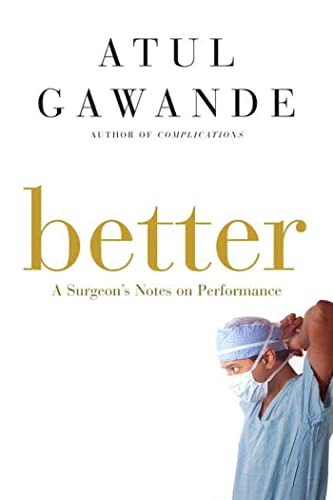
Cover of Better

Better

Atul Gawande

9 ideas

  1. Diligence as a moral demand

    Gawande argues that ordinary, unglamorous conscientiousness, such as consistent handwashing, saves more lives than heroic intervention. Better outcomes come from relentless attention to mundane detail under difficult conditions.

  2. Handwashing that no one sustains

    Despite knowing that hand hygiene prevents deadly hospital infections, clinicians comply only a fraction of the time because the demands of a busy ward overwhelm the habit. Changing behavior required redesigning the situation, not lecturing the staff.

  3. Positive deviance

    Rather than copying the average, study the outliers who achieve extraordinary results in the same conditions and learn what they do differently. Improvement comes from spreading the practices of the best, not enforcing the mean.

  4. Ingenuity is a duty, not a gift

    Gawande frames continual improvement as an obligation of practitioners who face imperfect systems and finite resources. To be better is a choice made repeatedly, not an inborn talent.

  5. Warren Warwick's cystic fibrosis centre outperforms

    When US cystic fibrosis centres' outcomes were compared, Warren Warwick's Minneapolis centre was at the top: its patients' median life expectancy was about 47 years, against roughly 33 nationally. The difference did not come from secret technology. It came from Warwick's refusal to accept normal lung function as 'good enough,' his aggressive pursuit of tiny declines, and his relentless pressure on patients to adhere to therapy every day.

  6. Performance as a bell curve

    In any field, practitioners' results fall on a bell curve, and most people are statistically average. The useful question is therefore not whether you are competent but where you sit on the curve and what separates the top from the middle. Making outcome data transparent forces that question, even though it exposes most practitioners as merely average.

  7. Five habits for becoming a positive deviant

    Gawande proposes five practices for anyone who wants to excel. First, ask an unscripted question to connect with people. Second, don't complain. Third, count something. Fourth, write something for others to read. Fifth, change: be an early adopter of new ideas. Each habit converts ordinary work into a deliberate cycle of observation, reflection and improvement.

  8. Simple scores that drive systemic improvement

    Virginia Apgar's 0–10 score for a newborn's condition at one and five minutes made infant health measurable. Obstetricians then competed to raise it, which pushed the field toward standardized, reliable techniques such as the Caesarean section. A crude but consistent metric can reorganize an entire discipline by giving practitioners something to count and improve against.

  9. Diligence beats genius in reducing harm

    Many deaths come not from gaps in knowledge but from failures to carry out simple, known tasks consistently, such as washing hands between patients. Closing that gap requires sustained, unglamorous attention to small details and system redesign, often by drawing on local positive deviants rather than issuing top-down exhortation.

Save and mark ideas in the app