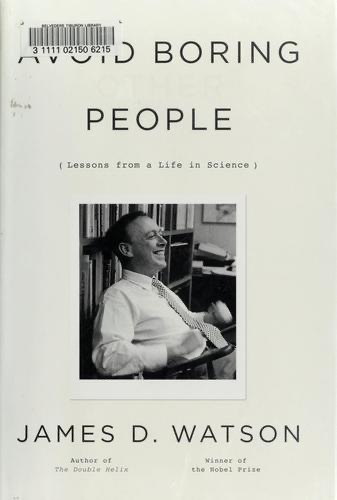
Cover of Avoid Boring People

Avoid Boring People

James D. Watson

5 ideas

  1. Seek competitors who exceed your ability

    Surround yourself with people smarter than you and choose problems where you are competing against the best minds, because the friction of being outclassed forces growth that comfortable superiority cannot. Avoid intellectual environments where you are the most capable person, as they let your standards quietly decay.

  2. Pursue problems ripe for solution

    Scientific success depends less on raw brilliance than on selecting a problem that is ready to be solved given current tools and knowledge — a hard problem attacked prematurely wastes a career. The art is recognizing when a previously intractable question has become approachable.

  3. Boring people as a fatal social cost

    Tedium is treated as an active harm in intellectual and social life, not merely a neutral lapse — dull conversation, overlong talks, and self-absorbed monologues repel the collaborators and patrons careers depend on. Cultivating wit, brevity, and genuine interest in others is therefore a professional survival skill, not just charm.

  4. Manners point sharpens scientific judgment

    Tackle a problem only when you can clearly state why no one has solved it, and prefer gathering hard facts to spinning elegant but untested theories. Knowing the precise obstacle blocking progress directs effort to the one experiment that could break the impasse.

  5. Watson and Crick Race Pauling to DNA

    In 1951 the 23-year-old American James Watson joined the Cavendish Laboratory in Cambridge, where he and Francis Crick set out to model DNA's structure instead of running experiments themselves, relying on X-ray data from Rosalind Franklin and Maurice Wilkins at King's College London. In early 1953 Linus Pauling proposed a flawed triple-helix structure, and Wilkins showed Watson Franklin's Photo 51. Watson then paired the bases using cardboard cutouts, and the two built the double helix, publishing it in Nature in April 1953 ahead of Pauling.

Save and mark ideas in the app