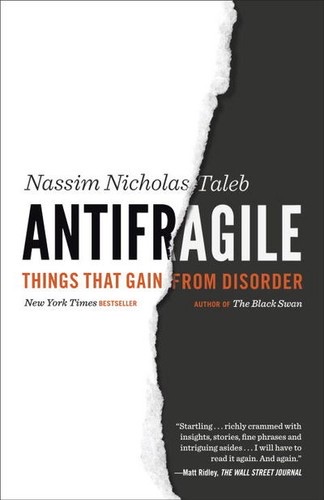
Cover of Antifragile

Antifragile

Nassim Nicholas Taleb

7 ideas

  1. Antifragility as Distinct From Robustness

    Things fall on a triad: the fragile breaks under stress and volatility, the robust resists it unchanged, and the antifragile actually gains from disorder, stressors, and randomness up to a point. Most thinking conflates 'robust' with 'antifragile,' but the antifragile improves under shocks rather than merely surviving them — like muscles that grow when stressed.

  2. The Lindy Effect on Survival

    For non-perishable things like ideas, technologies, and books, life expectancy increases with age rather than decreasing — every additional year survived signals greater expected longevity. What has existed for a long time has proven robust to time's stressors, making age a reliable filter for future durability.

  3. Skin in the game prevents fragility transfer

    Modern systems let decision-makers keep the upside while pushing the downside onto others. Bankers, bureaucrats, and pundits who suffer no penalty for being wrong transfer fragility to society. Stability requires that people who take risks bear their consequences, as in Hammurabi's rule that a builder dies if his house collapses and kills the owner.

  4. Barbell strategy for handling uncertainty

    Avoid the middle. Put most resources in extremely safe positions and a small share in highly speculative bets with open-ended upside. This caps the maximum loss while keeping exposure to positive surprises, whereas a 'moderate risk' middle holds hidden tail risk that is hard to measure.

  5. Via negativa: improvement through subtraction

    Under complexity and uncertainty, removing things such as harmful habits, unnecessary interventions, debt, or medications is more reliable than adding new ones. The effects of subtraction are better understood and less prone to unintended side effects. Knowledge of what is wrong is also more robust than knowledge of what is right.

  6. Suppressing volatility breeds hidden catastrophic risk

    When stabilizing institutions smooth away small fluctuations, such as central banks preventing mild recessions or foresters stopping small fires, fragility builds up unseen until one large blowup. Small, frequent failures release pressure and carry information. Removing them swaps visible noise for rare disasters.

  7. Fragility as convexity to harm

    To judge whether something is fragile, look at how harm grows with the size of a shock, not at predicted outcomes. If doubling the stress more than doubles the damage, the response is concave and the thing is fragile. If gains from variation outweigh losses, it is convex and antifragile. You can measure this asymmetry even when you cannot predict events.

Save and mark ideas in the app