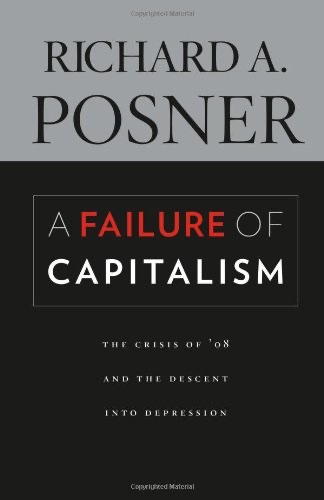
Cover of A Failure of Capitalism

A Failure of Capitalism

Richard A. Posner

6 ideas

  1. Depressions Are Rational Aggregate Failures

    The crisis was not caused by greed, stupidity, or fraud but by individually rational behavior — bankers, borrowers, and investors all responding sensibly to incentives that collectively produced systemic collapse. Rational profit-seeking under low interest rates and weak regulation aggregated into catastrophe, meaning the failure is structural rather than a matter of bad actors.

  2. Risky Lending as a Rational Bet

    When interest rates are low and asset prices are rising, taking on leverage and risky positions is the individually correct move because the upside is captured personally while the downside is socialized or shared. The very rationality of each firm's risk-taking is what makes the aggregate behavior dangerous and self-reinforcing.

  3. Deregulation Removed the System's Brakes

    Decades of financial deregulation and lax enforcement removed the institutional constraints that would have dampened the credit bubble, leaving no mechanism to slow rational but destabilizing risk accumulation. The absence of regulation was not neutral — it actively enabled the chain reaction once asset prices began to fall.

  4. Capitalism Requires Active Government Stabilization

    A market economy is inherently prone to bubbles and depressions and cannot self-correct in time to prevent severe damage, so government is a constitutive part of capitalism rather than an outside intruder. Viewing markets this way reframes regulation and bailouts not as betrayals of capitalism but as the maintenance work that keeps it functioning.

  5. Diagnosing Crisis Through Failed Self-Correction

    Analyze an economic collapse by asking why the normal self-correcting feedback loops — falling demand restoring prices, banks pricing risk, savers disciplining borrowers — stopped working at the system level. The breakdown occurs when fear and falling asset values create a deflationary spiral that individual rational responses (hoarding cash, deleveraging) only deepen.

  6. Economists' Ideology Blinded Them to Risk

    The economics profession's faith in efficient markets and self-regulating finance prevented experts from recognizing the building bubble, because their theoretical commitments treated severe depressions as essentially impossible. Intellectual ideology, not lack of data, was the binding constraint on foresight.

Save and mark ideas in the app