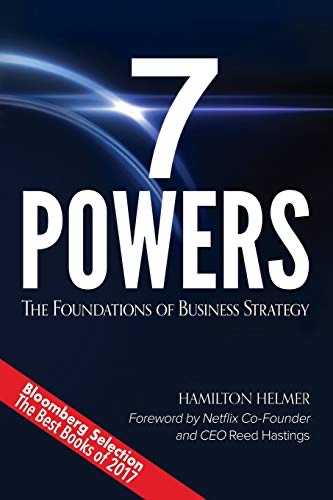
Cover of 7 Powers: The Foundations of Business Strategy

7 Powers: The Foundations of Business Strategy

Hamilton Helmer

7 ideas

  1. Counter-Positioning and the Netflix-Blockbuster Case

    Netflix's subscription-by-mail model destroyed Blockbuster's late-fee-dependent store economics, and Blockbuster could not match it without abandoning its profitable retail footprint. This illustrates how an incumbent's strongest assets become the chains that prevent it from copying a counter-positioned challenger.

  2. Seven powers with distinct barriers

    Durable advantage comes from exactly seven sources, each paired with its own barrier. Scale economies (prohibitive cost of gaining share), network economies (unattractive cost of gaining share), counter-positioning (collateral damage), switching costs (customers would pay for lost value), branding (uncertain, lengthy reputation building), cornered resource (preferential access on attractive terms), and process power (hysteresis: embedded organizational know-how that takes years to replicate).

  3. Counter-positioning: rational incumbent paralysis

    A newcomer adopts a superior business model that the incumbent does not copy, because copying would damage its existing business, as Vanguard's index funds threatened active managers' fee income. It is not incompetence or inertia.

  4. Power windows depend on business stage

    Different powers can only be established at particular stages of a business's life. Counter-positioning, cornered resource, and network or scale effects are typically seized during origination and takeoff. Branding and process power emerge during stability. Missing the window usually means the power cannot be acquired later, so timing is part of strategy.

  5. Power as benefit plus barrier

    Power is the set of conditions that let a business sustain differential returns, and it requires two things at once: a benefit that improves cash flow through higher prices, lower costs, or reduced investment, and a barrier that stops competitors from arbitraging that benefit away. A benefit without a barrier gets competed down to nothing. A barrier that protects no benefit is worthless.

  6. Invention precedes power

    Every durable power is built on an initial invention in product, process, business model, or brand, and that invention usually starts as a compelling value offering rather than a moat. Power follows from creating something customers strongly want and then finding the barrier that protects it. Analysis alone does not produce power.

  7. Operational excellence is not strategy

    Improving operations toward best practice is necessary, but it is not Power, because competitors can copy best practices and arbitrage the gains away. Treating efficiency as a moat mistakes an imitable benefit for a protected one. Strategy must instead ask what barrier keeps rivals from matching the improvement.

Save and mark ideas in the app